
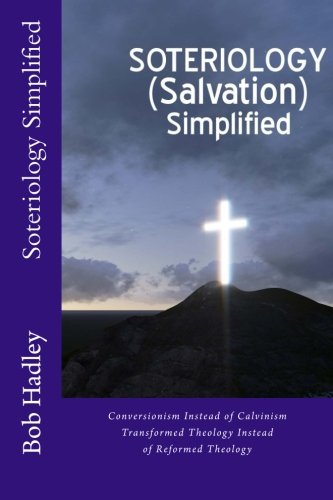
I recently purchased the book, Soteriology Simplified, which states on the back cover that, “All men are both responsible and response-able to respond to God’s initiatives in redemption, revelation and reconciliation.” This intuitively makes sense to me. To which, I’m hoping to have more “bullets in my gun” with which to better counter the arguments put forth by Calvinists. Living in the “land of Piper” (Twin Cities MN), I’ve found Calvinism to be a thorn in my side for longer than I’ve even understood what it was that Calvinists believed and taught. I’ve stated before that within my own dealings with Calvinists and non-Calvinists alike, I’ve discovered multitudes of smart and good-willed people on both sides putting forth persuasive arguments. The conundrum, then, is that many of the same scriptures are used to argue both sides of the spectrum which has led me to wonder if Christianity isn’t little more than a faith based on personal-opinion. I readily admit that my opinion on Christian doctrine is largely based on my antipathy toward Calvinistic thought and how I view the nature and character of God through the Calvinist’s lens. Nevertheless, my having “bad feelings” toward Calvinism doesn’t make it wrong.
Although I haven’t gotten very far in the book, I’m impressed that author Bob Hadley has nearly 550 references. The book looks to be well thought-out, clearly written with lots of references and I look forward to reading it. It may be true that for most people, the issue of Calvinism’s limited atonement (ref pg 11) is the fundamental point of contention. However, for me, it’s unconditional election. It’s my sense that if my arguments can undermine the concept of unconditional election, then limited atonement is less problematic. Granted, I understand how unconditional election must logically follow limited atonement. But I find the notion that God withholds the ability of some from coming to faith abhorrent and revealing an undeniability that God (per Calvinist doctrine) has not only chosen some for grace, he’s also intentionally chosen some for destruction.
I’m delighted to have this book on my shelf and will plan to write a more substantial review after reading it.
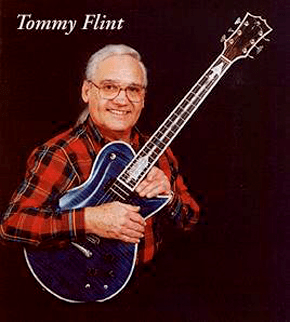 Just received news that Tommy Flint, 82, has passed away in Nashville TN. As a high tribute to his gentle and humble ways, Tommy could well be one of the best known guitarists that no one ever heard of. He performed with all the top notch players, wrote dozens of guitar instructional books and I was fortunate enough to have had Tommy as my first guitar teacher from 1967-68 when I was in junior high school. He taught out of Broadripple Music Store in Indianapolis IN. Tommy took me through three Mel Bay books over the ~2yrs I took lessons from him. He also helped my parents choose a Gibson Melody Maker that was given to me as a Christmas present. Tommy was a phenomenal teacher and helped me establish a good foundation in reading music and general guitar technique. He also taught me to play great tunes like Pipeline, Wipeout and Walk Don’t Run. Unfortunately at the time, I had no idea who Tommy was. Nor did I understand just how great of a player he was. Once in a while, though, after tuning up my guitar prior to a lesson, he’d “let loose” with some little riff. Wide eyed, I’d watch in amazement and ask him to teach me that. He’d smile and as much say something to the effect that I wasn’t quite ready for that but if I kept practicing then I’d get there soon enough.
  Calvinists claim something called limited atonement – the reconciliation of God and “the elect” through the sacrificial death of Christ on the cross. Calvinists deny that Christ’s atonement was for everyone. If atonement was for everyone, then everyone would be saved – or so the argument goes. And, of course, not everyone is saved so therefore Calvinists argue that Christ’s atonement was only for the elect. I don’t make that connection myself. But this makes me wonder – is atonement given to the elect person while they’re still in a reprobate condition? I mean, at what point is the elect person actually saved? Before the creation of the world? Or at the moment the elect person confesses their sin? Hence, if I follow the logic, it would seem that salvation is given to the Calvinist before any expression of faith.
  I like the insight
 Fundamental to the reservations I have regarding Reformed doctrine is the concept of unconditional election. Perhaps I’m deluding myself, but I think I can adequately refute the Calvinist’s notion of election. For instance, Eph 1:4 is a popular verse used by Calvinists.
 It’s been several months since leaving the church I had attended for ~12 years. Part of me thought that I would do more reading and studying during this absence. But I haven’t. In truth, I’m no closer to resolving questions I have regarding the nature and character of
 I finally shared with some friends the faith-struggles that I’ve been experiencing which have led me to leave the church I was attending. Afterwards, one of the guys sent me an email stating that he found my comment that Christianity has devolved into little more than personal opinions interesting. Turns out that I may not be the only one struggling with matters of faith. Although, it often seems that way. Still, this friend had an interesting perspective:

 Martin's Mercurial Musings