
I’ve certainly had my fair share of discussions and disagreements with Calvinists. As often as not, or at least within my limited sphere, I seem to encounter Calvinists who’re adamant that it’s God, “for his glory,” who has worked out EVERYTHING (including the free-will actions of people) per his [God’s] own sovereign will. Suffice it to say that I find much about this position troubling if only because there are literally hundreds of verses in which there are, for lack of a better word – suggestions regarding how we should go about decision making. For instance:
– The multitude of verses in the book of Proverbs
– Consider, too, how Paul went about making decisions (my interpretation)
· Phil 2:25 (I think it’s a good idea)
· 1 Cor 16:3-4 (If it seems the right thing to do)
· Acts 6:1-7 (We need to do something about this)
· Acts 15:24-29 (Believers got together, debated, decided, and acted)
Irrespective, this is how the one recent discussion went:
(Me) You’re stating that EVERYTHING is prescribed and otherwise ordained by God.
(CF – Calvinist Friend) Yes.
(Me) Then, if that’s true, you would agree that God brought about legalized abortion?
(CF) Well, we can’t think in God’s terms. We don’t have perfect understanding. Things that may not seem right to us make perfect sense to God.
(Me) Okay, I understand. But you would agree that all of mankind since Adam and Eve have been born with a sin nature?
(CF) Sure. That’s what total depravity is all about. None of us have it within us to live a sinless life much less even seek out a holy God. It’s God who has to put the desire to understand our sin nature much less bring us to faith in Christ to save us.
(Me) Fair enough. However, in spite of a sin nature, you would agree that unborn children have not yet sinned.
(CF) Well, I’m not sure that I understand your point.
(Me) Well, my point is that Jesus dying on a cross – his atonement for our sins is pointless.
(CF) Come again.
(Me) What I understand from your Calvinistic doctrine is that God intentionally destroys those who’ve never sinned.
(CF) Now wait a minute. I wouldn’t ever state that Jesus’ dying, his atonement for his elect, was for nothing. He knows his sheep. And we know him. He died to give us hope and eternal life. Also, your point that God destroys those who’ve never sinned is missing a particular detail.
(Me) Which is?
(CF) God has already chosen the elect – as it were from the foundation of the world. That is, God has already decided who he’ll reveal himself to. Those are the ones who Jesus died for. In addition, God, being able to see into the future because he’s not constrained by time, can know without a doubt which of those unborn children will never sin. It’s a safe bet that the number of unborn children who’ll never sin is zero. So, I don’t think it’s fair to state that God destroys those who’ve never sinned.
(Me) Fairness is God destroying those who’ve never sinned. Got it!
(CF) Sounds like you just don’t like having God in control.
(Me) No, I simply see too much in the Bible where it appears that God has provided us with principles on how we should go about making wise decisions. I think God gives us freedom and subsequently allows us to experience the blessings or consequences of those decisions.
(CF) I don’t trust in man. I trust in God.
The conversation more or less ended here. Sometimes when I think I have a significant point and toss it out, it often comes back as a contorted, albeit, logical explanation. Perhaps ‘dumping’ the abortion question into our little debate was unfair. But sometimes, when trying to understand something, it often seems reasonable to quickly take an argument to its logical conclusion. I don’t disagree that my Calvinist friend (more or less) effectively blunted my challenge. I don’t, however, find his argument persuasive if only because I can’t for a moment imagine a holy God bringing about a violent and abhorrent action upon an unborn child – whether that child was destined to sin or not. Maybe if I have another opportunity I’ll ask my Calvinist friend if he has ever voted for or against abortion laws. But, I guess that’s where I’ll have to leave it for now.
 how my understanding of Eph 1:4 is significantly different from what I hear and understand Calvinists to claim. In this verse (and passage) I believe Paul is laying claim that despite whether one is a Jew or Gentile, individuals are now being made right with God through faith and no longer through the law.
  I recently added a post to the effect that for many, limited atonement is the lynchpin of Calvinistic doctrine. That seems to make sense from a logical perspective. However, for me, the overriding issue is unconditional election if only because of how I perceive the character and nature of God through the lens of God choosing some while intentionally not choosing others. In any event, it seemed worthwhile to look up some limited atonement verses I often see used. Interesting because as often as not, there’s not a reference to the individual per se but for a group i.e. “but also for the sins of the whole world” – or something equivalent. To me, this is indicative of God’s desire for everyone without exception or exclusion.
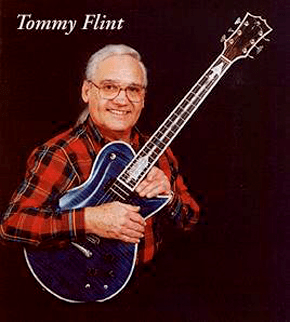 Just received news that Tommy Flint, 82, has passed away in Nashville TN. As a high tribute to his gentle and humble ways, Tommy could well be one of the best known guitarists that no one ever heard of. He performed with all the top notch players, wrote dozens of guitar instructional books and I was fortunate enough to have had Tommy as my first guitar teacher from 1967-68 when I was in junior high school. He taught out of Broadripple Music Store in Indianapolis IN. Tommy took me through three Mel Bay books over the ~2yrs I took lessons from him. He also helped my parents choose a Gibson Melody Maker that was given to me as a Christmas present. Tommy was a phenomenal teacher and helped me establish a good foundation in reading music and general guitar technique. He also taught me to play great tunes like Pipeline, Wipeout and Walk Don’t Run. Unfortunately at the time, I had no idea who Tommy was. Nor did I understand just how great of a player he was. Once in a while, though, after tuning up my guitar prior to a lesson, he’d “let loose” with some little riff. Wide eyed, I’d watch in amazement and ask him to teach me that. He’d smile and as much say something to the effect that I wasn’t quite ready for that but if I kept practicing then I’d get there soon enough.
  Calvinists claim something called limited atonement – the reconciliation of God and “the elect” through the sacrificial death of Christ on the cross. Calvinists deny that Christ’s atonement was for everyone. If atonement was for everyone, then everyone would be saved – or so the argument goes. And, of course, not everyone is saved so therefore Calvinists argue that Christ’s atonement was only for the elect. I don’t make that connection myself. But this makes me wonder – is atonement given to the elect person while they’re still in a reprobate condition? I mean, at what point is the elect person actually saved? Before the creation of the world? Or at the moment the elect person confesses their sin? Hence, if I follow the logic, it would seem that salvation is given to the Calvinist before any expression of faith.
  I like the insight
 Fundamental to the reservations I have regarding Reformed doctrine is the concept of unconditional election. Perhaps I’m deluding myself, but I think I can adequately refute the Calvinist’s notion of election. For instance, Eph 1:4 is a popular verse used by Calvinists.
 It’s been several months since leaving the church I had attended for ~12 years. Part of me thought that I would do more reading and studying during this absence. But I haven’t. In truth, I’m no closer to resolving questions I have regarding the nature and character of
