The Odds of Calvinism’s Unconditional Election

Small NumberThere was recently a discussion in which common grace vs special (or saving) grace was bandied about. Curiosity got to me, and I wondered just how special is God’s saving grace? And so, I looked up some numbers to calculate a ballpark figure. I’ll assume, for argument’s sake, that half of the world’s population of Evangelical Christians comprise God’s “elect”.  Therefore, if my math is correct; 0.5(600M/7.6B) = 3.95%. That is, God’s election is only extended to about four percent of the world’s population.

Put another way, for every soul born throughout the world, there is a likelihood of ~96% that the child is NOT of the elect. Well, at least I now know my approximate odds of God having found favor with me before the foundation of the world.

The Twin Faces of Calvinism

TwinsDear Jim,

I too have been a greeter at church. All too many greeters, however, seem content to sit at the door and say, “Good morning.” I rather enjoyed engaging with new attenders – the “newbies”. I sense we have something in common here and would absolutely agree that words of affirmation – such as you used with those teenage girls are huge. In fact, that’s one of the types of love languages that Gary Chapman talks about in his book The Five Love Languages.

As best as I’m able to comprehend, I try to live my life by the precepts within the Bible. It’s just easier. And, no guilt! Doesn’t mean I’m perfect. And, thank God, I don’t feel the need that I have to be perfect. Forgiveness is a wonderful thing – both in the giving and the receiving of it. Sadly, I am certainly more skilled in the receiving of forgiveness.

I appreciate the compliment regarding my analogy of the petri dish. Analogies eventually break down. But for now, that’s the best way to understand what you’ve stated to me as to God’s application of his sovereignty over man. That said, I have never before considered your perspective that the reason God ‘sovereignly does’ all this stuff is to prepare for what he has planned in heaven. I’ll admit, the thought is intriguing. But, at this point I’m inclined not agree. Perhaps the notion is still too much of a fatalistic position for me to swallow. The nature and character of God, as I understand him, isn’t at all fatalistic. Perhaps in my ignorance I could agree that in the OT God had things planned out much more so. But within the NT, I see Jesus with the woman at the well, bringing sight to the blind, feeding many, calling out the Pharisees for their hypocrisy, reasoning and helping his disciples to understand that he is indeed the Messiah. He came that we might have life. He loves all and wants none to perish. Perhaps it’s along the lines of in the OT God treated people like children. However, in the NT, I sense that God is much more so treating people like adults. Whatever …. minor ramblings. Sorry.

You and I will certainly disagree on the interpretation of any number of verses and how they may, or may not help justify Calvinistic doctrines. In part, that is why I used the analogy of the petri dish. Perhaps other analogies might work better. But this one seems to make sense – at least to me. If I may, allow me to toss out another analogy on how I see the application of Calvinism in general and unconditional election in particular.

Much as my own son has disowned me, I will always hope that he’ll change or otherwise, as it were, return much like the prodigal son. To which, I simply can’t image a father ever turning away from one of his own kids. I suspect that both you and I would be reviled at a father returning home from the hospital with his newborn twins – one of whom he favored over the other. The father made his determination long before the twins were born. The favored child received his father’s love and attention. He was given the best of everything. No benefit was withheld. The father even changed his will so that everything would be given to the favored child. All the while, the not-favored child was left wanting, not cared for, and would have to live in the garage. Further, there would be no interaction with his father.

Truly, Jim, I would welcome your thoughts on how this analogy is not a natural outcome or construct of Calvinism. I’ll look forward to your response.

Your Problem Is with God, not Calvin

Dried Tulips“I agree, just because I hate something doesn’t mean it’s false.”

That was my opening line responding to a Calvinist who stated that my anathema to the doctrines of Calvinism were because my “issue” is with God and not with Calvin. Seriously? Then, it ‘clicked’!

The difference in how Calvinists and non-Calvinists view the constructs and justification of Calvinism is that Calvinists start with Calvinism and try to make sense of Scripture. I start with Scripture and try to make sense of Calvinism. Calvinists have their “bullet-points” (TULIP) and go to great lengths to show that Scripture is indeed speaking “truth” to Calvinism. Scripture ought to be the foundation for all Christians. Further, the tension between Calvinism and what the Bible teaches is huge and I simply can’t understand how it is that Calvinists can hold to their tenants given the obvious tension of competing verses.

A Rachel Held Evans blog post several years ago got right to the core (for me) of what constitutes Calvinism.
– God creates disposable people, people without any hope.
– God sovereignly ordains, every war, abortion and rape.
– God does not love the world but instead hates it and delights himself and finds glory sending people to hell.

Calvinists believe that God predestined them to heaven. But I find it ironic that Calvinists will rarely admit the opposite truth as well that God predestines (i.e. determines from the foundation of the world, no less) to send the vast and overwhelming majority of people to hell? Call those who’re elect “the remnant”. I guess that sounds more spiritual. And yet, is there anything more clearly stated in the Bible (John 3:16) – for God so loved the world? And no, that doesn’t mean everyone automatically enters heaven. Rather, Jesus has paid the price and God allows the free-will choice of every individual. God wants none to perish (2 Pet 3:9). No one is intentionally excluded – as Calvinism would have you believe. In the end, it’s difficult for me to ascribe to Calvinist theology if only because my understanding of Calvinist theology makes God out to be arbitrary and capricious.

Lastly, every Calvinist I know is adamant they’re part of “Team Elect”. However, Calvin writes (Institutes of Religion 3.2.11) that God not only reveals himself to his elect, but that God also reveals himself to the reprobate. Further, God instills within the reprobate a sense of God’s goodness and mercy to the point where the reprobate even believes God loves him and has mercy for him? According to Calvin, then, the reprobate is only enlightened with a present and not eternal sense of grace. Therefore, any conviction the reprobate experiences will never lead to salvation. God, per Calvin, is a manipulator and otherwise toys with those he plans to send to hell. How nice.

Consider then – it only stands to reason that some who think they’re part of “Team Elect” are actually on “Team Reprobate” Per Calvin, God has given various reprobates a sense of right and wrong, a sense of godliness. Perhaps these reprobates sense an inner spirit indwelling within. But unless those on Team Elect disagree with Calvin (and I’ve yet to find any Calvinist who’s in disagreement with Calvin), how can anyone have any sense of eternal security? How does confusion not reign supreme in making the distinction between knowing whether one is a member of “Team Elect” or that God has instead determined (before the foundation of the world, no less) that you’re a member of “Team Reprobate”?

Predestination – A Problem of Definition?

 
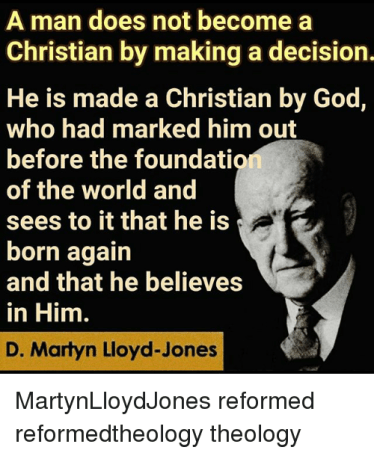
Martyn-LloydI recently read this D. Martyn Lloyd-Jones quote which is certainly a tenant of unconditional election within Classical Calvinism. Any reader of this blog will know the Calvinist’s definition of election is a bit of a thorn in my side. To which, if the above statement by Lloyd-Jones is indeed true, then logically, the opposite of his statement is also true. Kind of like John 8:32 which states you shall know the truth and the truth shall set you free. So, if the truth sets us free, then its opposite is also true wherein error binds or otherwise does not make us free. So, because it’s clear that people go to Hell, then I think it safe to infer from Lloyd-Jones to the effect that God has marked a select few to salvation before the foundation of the world, then it is also clear that God has determined (selected?) that the [some/many/most/overwhelming majority] are not born again and that they won’t believe in Him. In short, God chooses who’ll be saved. And therefore, by default, God also chooses who’ll be damned to Hell.

For many, this is the heart of free will vs predetermination. I reject the Calvinist notion of election in part because the Bible is replete with verses commanding folks to repent of their sin and to believe – in salvation through faith. If indeed, as Calvinists claim, that salvation is ‘given’ to only a select few, they why so many verses exhorting people to believe?

I’ve been told by Calvinists that, “If we can add anything to our salvation, then we are saying that Jesus’ dying on the cross was an insufficient propitiation for our sins.” I don’t disagree that our finite minds can fully comprehend an infinite God. Perhaps it is true that the two lines of God’s sovereignty and man’s responsibility can only intersect in the mind of God. But I don’t sense that there is so much difficulty in understanding that a) God has offered to everyone a way of salvation and b) it is man’s responsibility to accept that offer.

Edwin Lutzer from Moody College has stated that predestination is a difficult doctrine to understand and that there is a lot of mystery involved. Lutzer definition of predestination is, “God predetermining what happens on earth and that he predetermines you and your salvation”. He references Eph 1:4 as part of his justification for believing God determines specific individuals for salvation – which says – For he chose us in him before the creation of the world to be holy and blameless in his sight.

I remember being in a special reading where the teacher suggested I try omitting the prepositional phrases to better understand the “main point”. As is, a preposition links nouns, pronouns and phrases to other words in a sentence. We may lose details – but I don’t think that is the case here: (For) He chose us (in Him) (before the creation) (of the world) to be holy and blameless (in His sight).

Without the prepositions, then, Eph 1:4 says; He chose us to be holy and blameless.

The word “chose” in my Webster’s dictionary has different meanings including: “to select freely and after consideration” and “to decide”.

Therefore, using Webster’s common English understandings for the word “chose”, I believe a fair interpretation of this verse is that God decided that we were to be holy and blameless before he created the world.

In other words, God predestined that we were to be holy and blameless before he created the world. As I understand it, how that comes about was with the law in the OT and faith in Christ in the NT. I see nothing here that God has already decided who’s “elect” and who’s “reprobate”. Given that the Bible is replete with commands to repent and to believe would seem to support a personal requirement of a free will decision to accept God’s offer of salvation.

So, how then does all this fit together? Well, much like an algebraic statement must reconcile itself to be considered “true” (i.e. the right answer), so too must our theology add up, reconcile and resolve itself. I recently read, “Theological words have established meanings.” When we don’t agree on definitions then it only stands to reason that we’ll end up with variance of thought. That is, when explanations don’t add up and don’t reconcile, then there are potential contradictions which could be indications of error. As to who has the correct definitions – in this case regarding the word ‘predestination’, well, that seems to be the question of the day.

To which, I find these thoughts from Jerry Edmon regarding a Calvinist’s understanding of predestination to be interesting:

If predestination is true, one is either eternally saved or eternally damned before birth.

If predestination is true, then the concept of choice is a cruel deception.

If predestination is true, then the thought of being a free moral agent is simply a pretense.

If predestination is true, then reaching out to the non-elect is nothing more than an exercise in religious recital.

If predestination is true, then the sharing of the gospel by the elect can only stir up false hope within the reprobate.

If predestination is true, then why bother sharing God’s love unless it is just some misdirected sadistic tease to those who can never have eternal life?

If predestination is true, then preaching the gospel only dangles a mirage about the river of life to those dying of thirst who’re not able to partake of its stream.

If predestination is true, then the term “whosoever” from John 3:16 is a lie.

The Logic of TULIP Doesn’t Stand Up

TevyeThere isn’t any doubt as to the human spirit. It is depraved. There are none righteous. All have sinned. All have fallen short of the glory of God. But are Calvinist’s correct in their belief that of no free will and that no one can accept God’s grace and offer of salvation of one’s own volition? Which makes me ask, if there’s no free will, then why is the Bible replete with so many verses exhorting people to “believe on the Lord Jesus”? I’m sensing an apparent disconnect. Something isn’t adding up. I chuckle when recalling a scene from Fiddler on the Roof:

Mordcha: Why should I break my head about the outside world. Let the outside world break its own head!

Tevye: He’s right. As the good book says, If you spit in the air it lands in your face.

Perchik: Nonsense! You can’t close your eyes wo what’s happ;ening in the world.

Tevye: He’s right.

Avram: He’s right? And he’s right? They can’t both be right.

Tevye: You know, you are also right.

Calvinists claim that good can only come from people who have been anointed with God’s grace and mercy. However, are there not a number of verses in which God honors or otherwise bestows his blessing and salvation unto the humble? God found favor in Mary, Noah, the rich young ruler and the Centurion – who was referred to as a righteous man. So far as I can tell, these folks were doing ‘good deeds’ on their own. And God took notice. It looks to me as though God used them ‘as they were.’ I see no indications that God infused people with his grace and mercy prior to their being used by God.

Paul explains the new covenant wherein Jews and Gentiles alike can receive salvation through faith in Christ. Rom 10:13 states that everyone who calls on the name of the Lord will be saved. To me, it is self-evident; everyone means everyone. Period. There’s no indication that those who ‘call on the Lord’ had received any special ‘ability’ to receive salvation. Rather, decisions to accept God’s grace appear to have been freely made. Regarding Acts 17:30, this only seems the logical inference where God commands all people everywhere to repent. Again, all people means all people. And, a command infers a requirement for the recipient to follow through in order for the command to have been effected. If this is not Paul’s clear intention, then why doesn’t Paul single out and encourage (or command) only the “elect” to get their act together and repent. Did Paul understand TULIP? If so, then why are the elements of TULIP so mysteriously shrouded and only ‘visible’ through awkward and non-linear logic and exegesis?

I agree that we can’t fit God into our own ‘little box’. We aren’t able to see the ‘big picture’ and we are not omniscient. And because of that, I’ve always been told that theology isn’t formulaic, mathematical or logical. Or is it? Are there not “standard formulas” such as simple [if : then] conditional statements such as, [if you] believe on the Lord Jesus [then] you will be saved. Wasn’t this exactly what happened to the thief on the cross when he said, “Remember me, Jesus, when you enter into your kingdom.” It’s sad and unfortunately that there are so many “variations of thought” from those working from the same “source material”. And because of these ‘variations of thought’, it’s not unreasonable to question a given answer to a theological question. Living in the Twin Cities, the divergent opinions of John Piper and Greg Boyd immediately come to mind and it’s nothing short of ironic that both of these men use many of the same verses to argue their respective position. This, then, only reinforces a contention that many people of faith have beliefs which may be little more than opinion.

I’m paraphrasing a note sent to me by Greg Schumacher from a Facebook debate forum called Examining Calvinism. He says:

Truth isn’t some magical or mystical secret. Rather, truth is an equation of thought and reason. Truth adds up. Truth reconciles. Truth resolves itself. Theological words have established meanings and when people don’t use these meanings, and are instead creating variations of their own beliefs, ignorance or dishonesty.

People are confused about what reality is. Reality isn’t what you think and feel is real to you. That’s just wishful thinking. Rather, reality is the record of what has happened. Consider that a stock chart shows the record of what has happened and is not a prediction of what might happen. Reality is our present state of life. We see it because it has already happened. Our memory is a record of the preceding events. What has already happened is the reconciled reality of all the inputs that contributed to the state or condition.

Any theology which denies reality is little more than nonsense, imagination and fantasy. Reality is the most profound gift of God for us in life. It tells us everything. All factors of all truth are reconciled in the reality of the record. Truth is consistent. The principles of truth, the precepts, the rules are logical and even mathematical. 1+2=3 is the same across all platforms. Theological contradictions are therefore indications of error, lies and confusion. If there are theological contradictions then truth is not present.

The obvious inference – when explanations don’t add up and don’t reconcile then there are potential contradictions and indications of error. It’s unfortunate how many will create long dissertations in an attempt to justify incongruent beliefs only to end up with silly statements and no logical resolution. The Bible’s teaching, to me, is that reason leads to truth. And truth can be logically deduced. Reason provides the understanding of truth. To which, definitions matter. And definitions should hold up to the scrutiny of a given challenge.

In my opinion, then, Calvinism’s adherence to TULIP, and especially the element of Total Depravity and Unconditional Election, provide significantly more confusion than resolution. This confusion unfortunately leads to the impression (at least for me) that God is not the author of life, love and mercy but is instead a callous and heartless being incapable of being known.

A Distinction Between Calvinistic “Truth” and the Savior?

090427-south-dakota-badlands-trip-042It finally ‘hit me’ during a discussion with a Calvinist regarding unconditional election. I sensed my Calvinist friend (CF) didn’t think I was one of God’s ‘elect’. So, I asked:

Me: Do you believe that it’s possible for someone rejecting the doctrines of grace, i.e. Calvinism, to be a Christian?

CF: Sure, it’s possible. God is using Calvinists to guide everyone else to the truth. In fact, it’s not even Calvinism. It’s the gospel of Jesus Christ! Twenty years ago I was an obstinate Arminian until I tasted the sweetness of the gospel of God’s sovereign grace! God lifted me from the error of my thinking that I can by my own free will choose Him when I realized just how impossible it is for a sinner to turn to God by his own will.

Me: What I so often see is that ardent Calvinists such as yourself appear to be more in love with their doctrines than with their Savior. The TULIP doctrines are preeminent. The relationship is secondary. Right or wrong, I’m sensing the same thing with you.

Interesting, too, that you and I have in essence journeyed in direct opposite directions with regards to matters of faith. I find it curious that God brought you into Calvinism while I believe, if anything, that God removed me from Calvinism. For years, I was clueless about Calvinism until a new pastor arrives at the church we were attending. He was a nice enough guy. But I sensed a significant difference in the overall emphasis of the service and sermons. Topics related to total depravity, unconditional election and limited atonement were, well, uncomfortable. I soon found myself in significant disagreement with the new pastor – and many of the congregants, too. I left and started attending another church. So, I can’t help but wonder if God not only removed me from what I believe to be the error of Calvinism but he also gave me an abhorrence of Calvinistic doctrine? Or, maybe you think I’m a complete reprobate pretending to be a Christian and in abject ignorance running directly towards the gates of Hell?

CF: Calvinists are so in love with their savior. That’s why we always strive for his truth! We can’t separate truth and the savior. When one falls, the other falls too!

Me: Did you just make a distinction between the “truth” and the savior? The “truth” is Calvinism? So, you must therefore believe that Calvinism and faith in Christ are intrinsically intertwined?

CF: There’s no way around it. The Bible emphatically teaches this.

Me: So, by your understanding, if I hate the “truth” aka doctrines of grace, then by default, I also must hate the Savior?

CF: When the Bible says that salvation is a free gift, it means that it’s up to God to give it to whomever He wills. That’s unconditional election. We don’t deserve it. We can’t attain it.

Me: Really? Well, in no way, shape or form do I see the doctrines of Calvinism connected to Christian faith. So, in your estimation, I must therefore be a reprobate without any hope?

CF: It’s up to God who is elected. Man can’t choose. Man is spiritually dead. Man is a spiritual corpse. How, then, can salvation depend on man’s will?

At this point the conversation turned back to unconditional election and some discussion about Eph 1:4. Nothing was going to be resolved. We’d both “shot our wads”. There was, again, an impasse. In hindsight, however, I found it somewhat disappointing that my Calvinist friend didn’t ask me about a conversion experience or any aspect of my relationship (or lack thereof) with Christ. I should have drilled down on this, However, during “the heat of the discussion” that thought didn’t occur to me. If anything, however, this conversation confirms my general sense that Calvinists are more interested in their TULIP doctrines than they are with a faith-based relationship with Jesus.

To which, I can appreciate that it might be just a teeny little bit awkward for a Calvinist to tell someone, “Well, it’s too bad that God didn’t ‘elect’ you. You’re toast. And, come judgment day; well, sorry. What can I say other than God, in his infinite wisdom, decided before the foundation of the world not to include you. Well, good-bye and ‘God bless’!” That would at least be honest. But as is, Calvinists tend to dilly-dally and dance around the obvious implications of their doctrines when dealing face-to-face with someone.

So, how is the argument ever resolved other than for anyone to agree with a particular perspective – whether pro-Calvinist or anti-Calvinist? And, therein lies the problem; good-willed people in both camps having diametrically opposed perspectives are in essence deciding to agree with or disagree with doctrinal beliefs and matters of faith. Christian faith, then, subjectively distills down to a matter of one’s opinion.

The Oft Repeated but Unresolved Discussion

DiscussionA recent discussion followed a somewhat a predictable path. I was (again) told that 2 Peter 3:9 was written to believers. As was explained, “God’s promises of salvation are intended only for ‘the elect’. If God wanted all people saved, then all people would be saved. But because of man’s fallen nature, man is spiritually dead. And spiritually dead people can’t respond to God. Only elect persons can respond to God because God pulls back the ‘sin-veil’ from them. And for reasons known only to God, not every person has had the ‘sin-veil’ pulled back and have thereby been given the gift of salvation. And, because God is sovereign and, for his own reasons, he has decided who are his “elect” and who is not.”

But I remain unconvinced if only because it just seems, well, a bit awkward to have to tweak, what is to me, the plain meaning of any number of verses in the Bible to eliminate the obvious intent of human free-will within the overall scheme of Christian theology. In the NIV, 2 Peter 3:9 states, “The Lord is not slow in keeping his promise, as some understand slowness. He is patient with you, not wanting anyone to perish, but everyone to come to repentance.”

Clearly – and obviously – God wants everyone to come to a point of salvation! Isn’t that the clear and simple reading of this verse? God is doesn’t want anyone to perish. So, it therefore seems obvious that the reason why some accept faith while others reject faith is because God has given each person the ability (aka free-will) to accept or reject his offer of salvation.

Well-meaning Calvinists tell me that to understand the essence of this verse, and other passages dealing with TULIP matters, studying the original Greek and incorporating a lexicon and concordance is required. Maybe there are details to be drawn out with the Greek. Using a good translation (I personally like the NIV – which, according to the preface, is a new translation put together from the best available manuscripts by many Bible scholars knowledgeable in the languages, cultures and history) ought to be sufficient to derive fundamental truths from the Bible without doing a word-for-word translation and correlation. I’ll concede that maybe there are details that could be missed. But what isn’t missed is the fundamental truth.

And for me, the fundament truth is that God so loved the world that he gave his only begotten son that whosoever believes in him will not perish but have everlasting life. Have to check, but I think there’s a verse to that effect.

I’m not sure how best to phrase it other than despite our sins (past, present AND future), God doesn’t just ‘zap’ us (believers and non-believers alike). Per God’s holy nature and being, an immediate death is just and deserved. However, we continue to live despite the sinful thoughts and actions we continue to engage in. I’ve understood that the delay of God’s judgement is his forbearance towards his creation. So, are we, believers and non-believers alike, essentially vessels of mercy because we’re receiving the unwarranted forbearance of God?

If that is true, then it only stands to reason that all those who’ve received the forbearance of God’s judgement, believers and non-believers alike, have received his grace. So, is the blood of Christ offered to all people or not? I would argue that God’s grace has been offered to all. And that it is up to individuals to accept or reject that grace.

To me, there’s a Calvinist’s “disconnect” which emphasis that God has limited his grace and atonement to a very few people aka ‘the elect’. Yet, I find it ironic to be around Calvinists – all of whom give God all the glory because OF HIS ABUNDANT GRACE (emphasis theirs!). And yet, the very words on which Calvinism is founded i.e. unconditional election and limited atonement indicate that the god of Calvinism is somewhat retentive with that grace.