
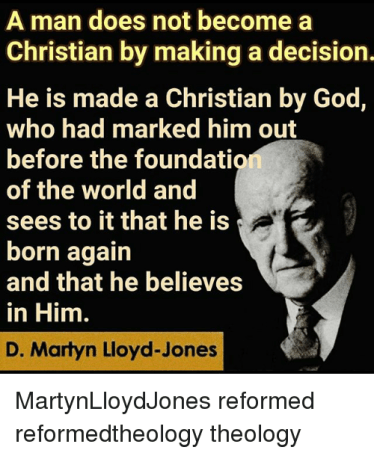
 I recently read this D. Martyn Lloyd-Jones quote which is certainly a tenant of unconditional election within Classical Calvinism. Any reader of this blog will know the Calvinist’s definition of election is a bit of a thorn in my side. To which, if the above statement by Lloyd-Jones is indeed true, then logically, the opposite of his statement is also true. Kind of like John 8:32 which states you shall know the truth and the truth shall set you free. So, if the truth sets us free, then its opposite is also true wherein error binds or otherwise does not make us free. So, because it’s clear that people go to Hell, then I think it safe to infer from Lloyd-Jones to the effect that God has marked a select few to salvation before the foundation of the world, then it is also clear that God has determined (selected?) that the [some/many/most/overwhelming majority] are not born again and that they won’t believe in Him. In short, God chooses who’ll be saved. And therefore, by default, God also chooses who’ll be damned to Hell.
For many, this is the heart of free will vs predetermination. I reject the Calvinist notion of election in part because the Bible is replete with verses commanding folks to repent of their sin and to believe – in salvation through faith. If indeed, as Calvinists claim, that salvation is ‘given’ to only a select few, they why so many verses exhorting people to believe?
I’ve been told by Calvinists that, “If we can add anything to our salvation, then we are saying that Jesus’ dying on the cross was an insufficient propitiation for our sins.” I don’t disagree that our finite minds can fully comprehend an infinite God. Perhaps it is true that the two lines of God’s sovereignty and man’s responsibility can only intersect in the mind of God. But I don’t sense that there is so much difficulty in understanding that a) God has offered to everyone a way of salvation and b) it is man’s responsibility to accept that offer.
Edwin Lutzer from Moody College has stated that predestination is a difficult doctrine to understand and that there is a lot of mystery involved. Lutzer definition of predestination is, “God predetermining what happens on earth and that he predetermines you and your salvation”. He references Eph 1:4 as part of his justification for believing God determines specific individuals for salvation – which says – For he chose us in him before the creation of the world to be holy and blameless in his sight.
I remember being in a special reading where the teacher suggested I try omitting the prepositional phrases to better understand the “main point”. As is, a preposition links nouns, pronouns and phrases to other words in a sentence. We may lose details – but I don’t think that is the case here: (For) He chose us (in Him) (before the creation) (of the world) to be holy and blameless (in His sight).
Without the prepositions, then, Eph 1:4 says; He chose us to be holy and blameless.
The word “chose” in my Webster’s dictionary has different meanings including: “to select freely and after consideration” and “to decide”.
Therefore, using Webster’s common English understandings for the word “chose”, I believe a fair interpretation of this verse is that God decided that we were to be holy and blameless before he created the world.
In other words, God predestined that we were to be holy and blameless before he created the world. As I understand it, how that comes about was with the law in the OT and faith in Christ in the NT. I see nothing here that God has already decided who’s “elect” and who’s “reprobate”. Given that the Bible is replete with commands to repent and to believe would seem to support a personal requirement of a free will decision to accept God’s offer of salvation.
So, how then does all this fit together? Well, much like an algebraic statement must reconcile itself to be considered “true” (i.e. the right answer), so too must our theology add up, reconcile and resolve itself. I recently read, “Theological words have established meanings.” When we don’t agree on definitions then it only stands to reason that we’ll end up with variance of thought. That is, when explanations don’t add up and don’t reconcile, then there are potential contradictions which could be indications of error. As to who has the correct definitions – in this case regarding the word ‘predestination’, well, that seems to be the question of the day.
To which, I find these thoughts from Jerry Edmon regarding a Calvinist’s understanding of predestination to be interesting:
If predestination is true, one is either eternally saved or eternally damned before birth.
If predestination is true, then the concept of choice is a cruel deception.
If predestination is true, then the thought of being a free moral agent is simply a pretense.
If predestination is true, then reaching out to the non-elect is nothing more than an exercise in religious recital.
If predestination is true, then the sharing of the gospel by the elect can only stir up false hope within the reprobate.
If predestination is true, then why bother sharing God’s love unless it is just some misdirected sadistic tease to those who can never have eternal life?
If predestination is true, then preaching the gospel only dangles a mirage about the river of life to those dying of thirst who’re not able to partake of its stream.
If predestination is true, then the term “whosoever” from John 3:16 is a lie.
 There isn’t any doubt as to the human spirit. It is depraved. There are none righteous. All have sinned. All have fallen short of the glory of God. But are Calvinist’s correct in their belief that of no free will and that no one can accept God’s grace and offer of salvation of one’s own volition? Which makes me ask, if there’s no free will, then why is the Bible replete with so many verses exhorting people to “believe on the Lord Jesus”? I’m sensing an apparent disconnect. Something isn’t adding up. I chuckle when recalling a scene from Fiddler on the Roof:
 A Calvinist pastor from a church I used to attend put this comment up on Facebook:
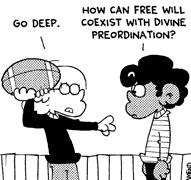 What follows is an as-best remembered rendering of a recent discussion with a Calvinist friend (CF) as to the use of the phrase ‘free will’ instead of ‘choice’.
 We periodically receive a catalog from
  It finally ‘hit me’ during a discussion with a Calvinist regarding unconditional election. I sensed my Calvinist friend (CF) didn’t think I was one of God’s ‘elect’. So, I asked:
 how my understanding of Eph 1:4 is significantly different from what I hear and understand Calvinists to claim.
  I recently added a post to the effect that for many, limited atonement is the lynchpin of Calvinistic doctrine. That seems to make sense from a logical perspective. However, for me, the overriding issue is unconditional election if only because of how I perceive the character and nature of God through the lens of God choosing some while intentionally not choosing others. In any event, it seemed worthwhile to look up some limited atonement verses I often see used. Interesting because as often as not, there’s not a reference to the individual per se but for a group i.e. “but also for the sins of the whole world” – or something equivalent. To me, this is indicative of God’s desire for everyone without exception or exclusion.
 Martin's Mercurial Musings