
A Calvinist’s Perspective on Jn 3:16

The below post is a letter that a good friend and an ardent Calvinist (who just happens to be the husband of my daughter) recently gave me in response to my contention that Jn 3:16 (along with 2 Pet 3:9, Rev 3:20. Tit 2:11, 1 Tim 2:3) refutes the concept of election. Mike was kind enough to provide a detailed response to each of these verses. Hopefully on subsequent posts I’ll respond to those other verses. However, with this post, I’m focusing in on Jn 3:16. Mike’s letter is heartfelt and reflects the passion and commitment he has for his Christian faith. Mike is heavily involved in Equip Campus Ministries at South Dakota State University and I would encourage people to check out their web site: www.equipsdsu.org. I appreciate Mike and with his permission, I’m pleased to offer his letter for the reader’s consideration. I’ll post my response to this letter in the comments section.

Jn 3:16

For God so loved the world that He gave His only Son and that whoever believes in Him should not perish but have eternal life.

Arminian Interpretation: God loves the entire world, meaning every single individual in the world. However, He has also designed the world in such a way that only believers will have eternal life.

Calvinist Interpretation: God loves the entire world, meaning every single individual in the world. However, He has also designed the world in such a way that only believers will have eternal life.

So what’s the problem?

I think it’s helpful to notice what question this text doesn’t address. It doesn’t address the question for why some do believe and others don’t. All Jn 3:16 says is that God saves the believers.

Why do some believe and others don’t?

We must admit that Jn 3:16 doesn’t answer this question. Here are a few examples within John that will suggest that belief starts with God and not man.

Jn 3:5-8 Truly, truly, I say to you, unless one is born of water and the Spirit, he cannot enter the kingdom of God. That which is born of the flesh is flesh, and that which is born of the Sprit is spirit. Do not marvel that I said to you, ‘You must be born again.’ The wind blows where it wishes, and you hear its sound, but you do not know where it comes from or where it goes. So it is with everyone who is born of the spirit.

Thoughts:  It seems like we were born of the Spirit the same way we were born of the flesh. When I was born of the flesh, I played no part in my birth. My birth was 100% a result of my parent’s choice. So it is with my spiritual birth. It has nothing to do with me, but everything to do with God. From our perspective, John says it’s like the wind, you don’t know where it comes from or where it goes.

Jn 6:28-29 Then they said to him, “What must we do, to be doing the works of God?” Jesus answered them, “This is the work of God, that you believe in him whom he has sent.

Thoughts: The people want to know how they can be doing the works of God. Jesus replies by saying, “This is the work of God, that you believe in him whom he has sent.”

Observation:

Belief is a work. Which presents a problem because Eph 2:9 says that salvation is not a result of works.

But this works because Jesus says that our belief is a work of God, not a work of man.

This is like Jn 1:12-13 that says, “To all who did receive him, who believed in his name, he gave the right to become children of God, who were born, not of blood, nor of the will of the flesh, nor of the will of man, but of God.

Jn 10:24-28 So the Jews gathered around him and said to him, “how long will you keep us in suspense? If you are the Christ, tell us plainly.” Jesus answered them, “I told you, and you and you do not believe. The works that I do in my Father’s name bear witness about me, but you do not believe because you are not part of my flock. “My sheep hear my voice, and I know them, and they follow me. I give them eternal life, and they will never perish, and no one will snatch them out of my hand.”

Observations:

Jesus is answering the question we posed about, namely, “who do some believe and others don’t?”

His answer to why the Jews don’t believe is, “because they are not a part of his flock.”

In other words, those who are a part of Jesus’ flock will believe.

Again, to put it another way, being a part of Jesus’ flock is the prerequisite for belief. If we are in Jesus’ flock, we will believe. If we are not in Jesus’ flock, we will not believe.
Please Pass the Salt & Grace

I read with interest an article sent to me entitled, Two Views of Regeneration, by John Hendrxy that compares:

  • Monergism – the doctrine that the human will possesses no inclination toward holiness (until regenerated) and therefore cannot cooperate in regeneration.
  • Synergism – the doctrine that the human will and the divine Spirit cooperate in regeneration.

An attached link pointed me to this site: www.monergism.com.

My NIV Topical Bible states that regeneration, in essence the act of being born again, results in salvation.

Monergism vs. Synergism. Sounds like a lawsuit, doesn’t it? This discussion has been around since before the flood. Well, it is probably more accurate to state that this topic has been around since the days of John Calvin and Jacobus Arminius. In any event, John Hendrxy states, [the] “unscriptural view (of synergism in general and of prevenient grace in particular) is the greatest threat to a true understanding of salvation in the Church today.”

The arguments and evidence presented by Mr. Hendrxy are, to say the least, compelling. However, it doesn’t take much internet searching to find (to me, anyway) strong Biblical evidence to support the doctrine of synergism and the concepts of Arminianism. Is one obviously right and the other obviously wrong? Is there some middle-point wherein there is truth in both Calvinism and Arminianism?

I cannot help but think that this discussion is a microcosm of many different thoughts, ideas, perceptions, and understandings of various Christian thought and I find it disconcerting that so many Christians can have so many different and divergent thoughts as to:

  • The nature and character of God.
  • The life of Christ.
  • The manifestation of the Holy Spirit in the life of the believer.
  • Does God “control” everything or does He grant freedom?
  • Does God foreknow everything in the future or is there some openness?
  • The Genesis debate re old-earth versus young-earth.
  • Divergent opinions regarding women in ministry.
  • Speaking in tongues.
  • The Tribulation.

With regard to the Calvinists verses the Arminians, I am more comfortable with the Arminian arguments. Perhaps Colleen with her Greek lexicon and thoughtful arguments will persuade me otherwise.

There’s a lot of varied opinion within Christian circles about a whole host of issues and there is a lot of biblical substance to each of the arguments. A most interesting book, Across the Spectrum, argues from both sides of many significant on-going theological issues within the Evangelical Christian community. So, in backing away from the specifics of any particular arguments – at least in this post, I am asking:

  • Can we acknowledge that there are significant arguments for both Calvinism and Arminianism?
  • Conversely, can we acknowledge that there are significant objections to both Calvinism and Arminianism?

I like salt on my food and grace in my arguments as it tends to make both more palatable and more interesting. As always, I welcome thoughts and opinions.

Clarifying The Problem – Biblical Interpretation

Who knew that a four-hour statistical process-control review meeting would help clarify my struggle with aspects of the Christian faith? Perhaps it is inherent working within a chemistry/manufacturing environment to understand all of the known variables. One aspect of understanding the variables is safety related, of course. Another aspect of understanding the variables relates to the cost of doing business and ensuring that a quality product is the end-result. To that end, when process variables are in control, the outcome (in this case how well the final products works) can be accurately predicted and there will be a minimum of variance.

So, what’s the correlation (pun intended) of the day job with my faith? Part of my struggle revolves around divergent views as Calvinist, Arminian, open theist, or any other view for that matter. I presume that God has provided all that we mere mortals would ever need to know about Him through the Bible. So, how are fundamental beliefs so varied from one Christian to another? Why is my interpretation and understanding of Eph 1:4 entirely different from that of CJ Mahaney? Note: please see my previous post regarding CJ Mahaney’s sermon on sovereign grace and divine election. Is it possible, for instance, that I’m looking at the “mean value” while CJ Mahaney is looking at the “median value” within the same “data sets”? Is there more than one interpretation for this verse – or for passages within Lamentations 3 and Romans 9? Can we make sense of apparently conflicting passages of Scripture?

I’m paraphrasing a little: but if I hold to Christ’s teachings, I’ll know the truth which will set me free. Seems simple enough – and according to Bob George in his book, Classic Christianity, if the truth sets me free, then the opposite is true; error binds me up. Feeling conflicted about my faith; I suppose it would seem reasonable that I am in error. But am I?

Defining the terms

While recently searching for information on Calvinism I stumbled across a web site quoting material from The Five Points of Calvinism – Defined, Defended, Documented by David Steele and Curtis Thomas. I thought it would be beneficial to post my understanding of these terms and highlight the specific differences (at least related to divine election) that I have with my Calvinist friends.

According to Arminianism:

  • Salvation is accomplished through the combined efforts of God (who takes the initiative) and man (who must respond) with man’s response being the determining factor. God has provided salvation for everyone, but His provision becomes effective only for those who, of their own free will, “choose” to cooperate with Him and accept His offer of grace. At the crucial point, man’s will plays a decisive role. Thus man, not God, determines who will be the recipients of the gift of salvation.

According to Calvinism:

  • Salvation is accomplished by the almighty power of the Triune God. The Father chose a people, the Son died for them; the Holy Spirit makes Christ’s death effective by bringing the elect to faith and repentance, thereby causing them to willingly obey the gospel. The entire process (election, redemption, regeneration) is the work of God and is by grace alone. Thus God, not man, determines who will be the recipients of the gift of salvation.

The reason for my interest is that (I think) the Calvinist-Arminian debate goes to the nature and character of who we believe God to be. Feel free to post your thoughts and comments.

Sovereign Grace/Divine Election?

The following is a letter I wrote to a friend who recently lent me a CJ Mahaney DVD on sovereign grace:

I’ve listened to the CJ Mahaney you gave me re sovereign grace. I looked on CJM’s web site, www.sovereigngraceministries.org, but was not able to find this particular DVD on the mystery of divine sovereignty and human responsibility. In any event, CJM makes a compelling case for believing in divine election. However, if anything, I am more convinced in the error of Calvinism in general and divine election in particular because:

  1. CJM ascribes a meaning to Eph 1:4 that I don’t think the author intended.
  2. CJM appears loose with his definitions of words.
  3. CJM’s use of emotion and personal experiences related to his conversion (at age five) are not a strong enough argument for divine election in light of the totality of scripture regarding salvation.

According to CJM, Eph 1:4 says that Christians were chosen personally and specifically by God to be saved because we were chosen:

  • In Christ
  • Before the foundation of the world
  • To be holy and blameless

Without the prepositions, Eph 1:4 in the NIV version I have says; He chose us to be blameless. From my Webster’s dictionary, the word chose (choose) has different meanings including “to select freely and after consideration” and “to decide”. As such, rewording the verse slightly – God decided that we were to be holy and blameless before creating the world. In short, God created us without sin.

My simplistic understanding goes like this: God wanted fellowship with earthly creatures that were without sin. God created Adam and Eve – perfect, holy, and blameless and they enjoyed fellowship with God. God also gave A&E a free will and it wasn’t long before A&E sinned. God therefore booted A&E out of the Garden of Eden. Amazingly, God still desired A&E’s fellowship as well as the fellowship of everyone that would come from A&E. We go through the entire OT with all of its rules and regulations but God still couldn’t enjoy fellowship with us because we failed to uphold and obey His law. Amazingly again, God still desired our fellowship and set up a process whereby His own death would serve as a substitute punishment for our sin. To that end, I do not see that Eph 1:4 has anything to do with divine selection.

CJM’s perspective on how God enacts divine election was interesting – wherein God reaches out and stops some, but not all, of those who’re running straight to Hell. I thought about your example of choosing to pay off one brother’s mortgage but not the other. However, I’m not aware of scripture that paints the picture of God applying randomness or otherwise arbitrarily saving some but not others. As you know, I don’t accept your examples in Romans 9 because I believe the last couple of verses explain that chapter to be about those who have faith being saved i.e. the Gentiles against those who tried to keep the law and rejected faith i.e. the Israelites. As I understand it, Christ died once for all and every requirement for our salvation has been satisfied. All that God requires is for us to believe – which is something we must choose to do. I don’t see how God needed to do anything more i.e. choose some (the elect) and not others (the “deselect”).

CJM makes it sound as though the human condition is not able to seek out truth, justice, or righteousness. The Bible is clear – all have sinned and fall short of the glory of God. However, if we are created in His image, then doesn’t it make sense that we have been given the ability to know and understand right from wrong, good from evil – at least to varying degrees. Clearly, there are various levels of evilness throughout humanity. Any rational person would categorically state that Adolph Hitler was “more evil” than Mother Theresa. If we are able to make that distinction, then isn’t it possible that we can also see and indeed desire the holiness of God. We may not understand the ramifications or the costs of that holiness and our sin nature will forever prevent us from being truly holy. But that’s why Christ came. We are holy and blameless, in Christ, because of the free gift that we have chosen to accept.

CJM laid out the fruit of election as being:

  • Humility before God
  • Assurance from God
  • Gratefulness to God

Fine and well – but show me the scriptural references. Is there such a thing as “the fruit of election”? On the other hand, is this something made up to sound spiritual and to help argue the merits of divine election? Without scriptural references, I can only surmise that “fruit of election” is a made-up concept. In contrast, I can point you to Gal 5:22 regarding the fruit of the Spirit.

Regarding word definitions, CJM stated, “Repentance is a way of admitting that we can not save ourselves.” My Topical NIV states that repentance involves a conscious sorrow for one’s past way of life – a heartfelt “I’m sorry” expressed to God – turning away from an old way of living. Of course, I don’t believe that I can save myself. Most Christians, at least within the evangelical circle I run in, understand that it was our accepting the free gift of Christ’s sacrifice for our sins that has saved us. To be honest, I’m not even sure that one has to “feel” sorrow or remorse to become a Christian. I don’t know of any reference for that. On the contrary, we repent because we understand that we have fallen short of the holiness that God desires in all of His children.

Well, this is probably a good place to stop. Take care and I look forward to your response.

Sincerely,

Bob

Books I’ve Been Reading

It certainly has been my intention to write more often than I have.  However, sometimes life i.e. family, job, and normal everyday mundane things get in the way.  I’ve been asked – what have I been reading?  Well, the books I have been reading (or re-reading) include:

  • Discovering God’s Will For Your Life (Ray Pritchard)
  • Is God Really In Control (Jerry Bridges)
  • Is God to Blame (Greg Boyd)
  • Living Above Your Circumstances (Bob George)
  • The Purpose Driven Life (Rick Warren)
  • God’s Will, God’s Best (Josh McDowell & Kevin Johnson)
  • Decision Making and The Will of God (Garry Friesen)
  • The Mystery of God’s Will (Charles Swindoll)
  • What is the Will of God and How Do We Know it? (John Piper sermon)

I know there is a whole boatload of books and information about this topic and I don’t pretend to have even scratched the surface.  However, this is where I have started because these books were in our church’s library or someone has referred me to them.  Please post other books that you may have found relevant to this topic.

A Desire for Truth Pertaining to the Will of God

The issue of God having a specific plan for each believer is something that I have been trying to understand for a long time.  Until recently, I would “agree to disagree”.  I accepted that I did not have sufficient understanding to comprehend this issue and I was content to leave it at that.  Then, I came across a book entitled Decision Making and the Will of God.   For the first time, I found myself (I think) thinking Biblically about the nature of God’s will in my life.  I did not have to “discover” what God had planned for me.  I did not have to figure out what His personal will is for my life.  Per Garry Friesen’s book, God’s will is clearly stated in scripture.  I did not have to deal with those proverbial open or closed doors anymore.     

As the saying goes, a funny thing happened on the way to church.  I kept hearing what sounded like (to me, anyway) “Christian speak” type statements.  Many devout believers are convinced that God has/had shown them a plan for their lives.  They have “peace in their hearts”, “a clear conscience”, and scads of verses to support their contention that God had given them a particular house, led them to their spouse, children, opened the door for a job, gave them a disease and then cured them of it, etc.  I’ve never experienced anything like this.  Was I missing something?       

This issue began to “fester” and really gnaw at me when the pastor and members of the board at our church were talking about whether or not it was “God’s will” to have a building expansion program.  I asked the obvious question, “What are the criteria to determine whether or not a building program would be part of God’s specific plan for this church?”  It seemed a simple enough question.   However, this led to many conversations and emails with the pastor and many others in the church over the next couple of months.  In the end, I became uncomfortable with the pastor and the church leadership and left to worship at another church.       

So, what is my point: much as a chemist sets out to prove (or disprove) a hypothesis, I am trying to validate my belief that God gives the believer freedom to make any choice that is within His moral boundary (His law).  I do not believe that God has a predetermined objective for us to discover.       

A good question as been asked of me – am I in pursuit of truth?  In addition, am I willing to follow the truth wherever it leads?  I wish I could give a straight-up “yes!” answer.   However, I think I am coming to grips with how little faith I truly have.  I am confused and I can no longer swallow the nice little expressions of faith – the “Christian speak”.  For example: in an Aug/Sept 2003 Focus On the Family article on Joni Eareckson and Ken Tada, Joni says, “But God has a plan.  It’s no mistake that you got that bad medical report last week, that the economic downturn is affecting your retirement fund, that your children are not turning out the way you’d hoped they would or that your grandchild was born with a disability.”  Certainly these are things that can draw individuals and families closer to Christ.  And certainly God can use any situation for His glory.  But I am not convinced that God has brought about those situations.              

Well, I trust that I have provided a little perspective regarding my concern and confusion as to the will of God in the life of the believer.  I welcome thoughts, opinions, and the opportunity to engage in a dialog.  I look forward to posting on various books I have read, and statements that I have come across where I find myself in disagreement as to the will of God from people such as Jerry Bridges, John Piper, Josh McDowell, Ray Pritchard, and Rick Warren.  So, stop back from time to time and we will see where this journey leads.   

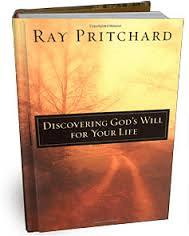
A Review of Ray Pritchard’s book, Discovering God’s Will for Your Life

ray-pritchardAuthor Ray Pritchard states in his book, Discovering God’s Will for Your Life, “Nothing is more comforting to the child of God than knowing that amid the confusion of everyday life God is slowly leading him or her along the path of his will.  In fact, he (God) is working in and through your decisions (and often in spite of your decisions) to see that his will is actually done in your life.”

Mr. Pritchard, references Proverbs 3:5-6 in chapter five – How to Make a Tough Decision and highlights five words:

Trust

To trust in the Lord is to rest your whole weight upon

him – to depend on him completely.

Lean

To lean means to rest upon something for partial support

or when you are not strong enough to stand alone.

Understanding

Understanding refers to mental process by which you

analyze a problem.  Use all your mental powers, but do

not lean on them for total support.  Don’t trust in your

own ability to figure out your life.  Lean instead on the

Lord.  Rest your weight on him.

Acknowledge

In all your ways know him deeply and intimately.  It’s

the kind of knowing that comes with personal experience.

It means to know something through and through.

Direct

He will make your straight your paths.

So, then, according to Mr. Pritchard (emphasis mine), “Here is God’s message to you from Proverbs 3:5-6.  If you will know God in every area of your life, he will take personal responsibility to make your way smooth and straight.  He will remove the obstacles if they need to be removed.  He will fill in the pot-holes if they need to be filled.  He will redirect the detour so that what seemed to be a dead-end turns out to be the shortest way to reach your destination.”

However, if I look at Proverbs 3:5-6 in the context of the chapter, I come to a different conclusion.  The NIV Topical Bible I use has the third chapter of Proverbs under the heading of “Further Benefits of Wisdom”.  In addition, if I look at the headings of chapters one through four, I see:

Chapter 1:20-33            Warning Against Rejecting Wisdom

Chapter 2:1-22              Moral Benefits of Wisdom

Chapter 3:1-35              Further Benefits of Wisdom

Chapter 4:1-27              Wisdom Is Supreme

Also, Proverbs 3:5-6 are squarely in the middle of a bunch of verses that relate to various aspects of wisdom.  The NIV Topical Bible has a “theme verse” related to Proverbs 3:5 entitled, “Direction” which states:

  • The book of Proverbs offers direction for life by concentrating on those patterns operable in daily life that offer some measure of consistency.  For example, fearing God and shunning evil produces a healthy body.  Hard work brings rewards, whereas laziness courts disaster.  Consistent discipline of a child results in a well-adjusted adult.  Pride and arrogance lead to destruction.  The wicked die young while law-abiding citizens (the righteous) live long.  There may be exceptions to these rules, but generally we can depend on them.

I can only surmise that the people who produced the NIV Topical Bible did not see anything within Proverbs 3:5-6 related to:

  • God taking a personal responsibility
  • God making one’s way smooth and straight
  • God removing obstacles
  • God filling in “pot-holes”
  • God redirecting detours
  • God ensuring that we reach our destinations via the shortest way

In addition, Proverbs 3:1-10 are arranged in pairs i.e. 1-2, 3-4, 5-6, 7-8, and 9-10.

Verses

If you –

Then –

1-2

Do not forget my teaching

You’ll live long and prosperous

3-4

Let love and faithfulness never leave you

You’ll win favor and a good name

5-6

Trust in the Lord with all your heart

He’ll make your paths smooth

7-8

Are humble, fear the Lord, and shun evil

You’ll be healthy

9-10

Honor the Lord with your wealth

You’ll have plenty

Certainly, we can come up with exceptions to these “rules”.  And that’s the point!  These are not absolute statements!  They’re generalities!  The founder of The Navigators, Dawson Trottman, did not have a long life.  And yet, when I read his bibliography, it’s clear that he didn’t forget the teachings of the Bible.  And certainly his paths weren’t always smooth even though he trusted in the Lord with all his heart.

Mr. Pritchard uses a number of OT references i.e. Ex 13:20-22 and Num 9:15-23 to show how God used supernatural events and did indeed guide people.  The question for me, then, is can one use a singular historical event denoted in Scripture to ascertain a general mode in which God shows His will to all Christians.  Mr. Pritchard goes on to state that the secret of knowing God’s personal and specific will for each believer is to know God better.  For myself, I believe that any decision I make, so long as it is within the moral will of God, is pleasing and acceptable to God.  Perhaps I’ll post another time of my reaction to reading Gary Friesen’s book, Decision Making and the Will of God.

Rhythm Anchors

Jeff Wachter, a fabulous mandolin player, and I have gotten together occasionally over the last year or so to noodle around (that’s a musical term which means “to putz”) on jazz standards.  For grins and giggles we’ve played twice at The Sage Market’s end of the month open mic in Mendota Heights, MN.  Some pictures of us playing last month can be found here:

http://4guyswhoknownothing.wordpress.com/2008/02/28/rhythm-anchors-at-the-sage/

I had a chance to talk with the manager at The Sage Market after we played and she wanted to have us come and play “a real gig”.  Wednesday, June 18th from 6-9pm is the date.  Good food, a great wine selection, and (hopefully) wonderful background music should make for a nice evening.

Guitars & Mandolins

Music has been a passion for as long as I can remember and I feel blessed and fortunate to have some ability to express myself through the music I play.  I’m primarily a fingerstyle player and enjoy arranging and playing a variety of old hymns to jazz standards to The Beatles.  I own a couple of nice Taylor guitars (GAMC, NS62CE) and a Breedlove Alpine mandolin.  In addition, I have a Baby Taylor guitar that is currently undergoing some “reconstructive surgery” wherein I’m trying to convert this small-body guitar into an octave mandolin.  I’ll post some pictures and stories of “the learning curve” on that project soon.   A favorite “therapy” hangout place is The Podium, in Minneapolis, where they have a great collection of world-class guitars and mandolins.