Believing God’s Sovereignty in Sickness – and in Health, too?

I am saddened to hear of Joni Eareckson Tada’s breast cancer and only wish her the very best with her surgery and following treatments.  In the video, Joni said:

Our afflictions come from the hand of our all wise and sovereign God.

We believe that God can and does heal.

Given her own words, I sense that doubt is revealed and a lack of confidence in God’s ability to heal is displayed because Joni has sought out medical assistance through surgery and (presumably) subsequent chemotherapy and/or radiation.  According to Joni, it was God who determined that she was to contract cancer.  The question I seem to ask of Christians who make the assertions that God inflicts some with life-threatening disease (or any other kind of malady or calamity) is; do Joni’s actions in seeking medical treatment indicate that she really does rest in her stated view of God’s sovereignty and God’s will in the matter of her healing?

Update: From the latest video and posting on her site above, it’s good to hear that Joni appears to be doing well after surgery.

Update (7/6): Joni continues to recover after her surgery.  I’ve enjoyed reading the comments that people have posted.  Although I have my doubts that it was God who brought about cancer within Joni, it is apparent Joni that has peace about the whole situation and her faith is a testament to God working out all things for the good of those who love him and are called according to his purpose (Rom 8:28)

A Sleep-Study; It’s a ‘Weird’ Feeling – Feeling ‘Wired’

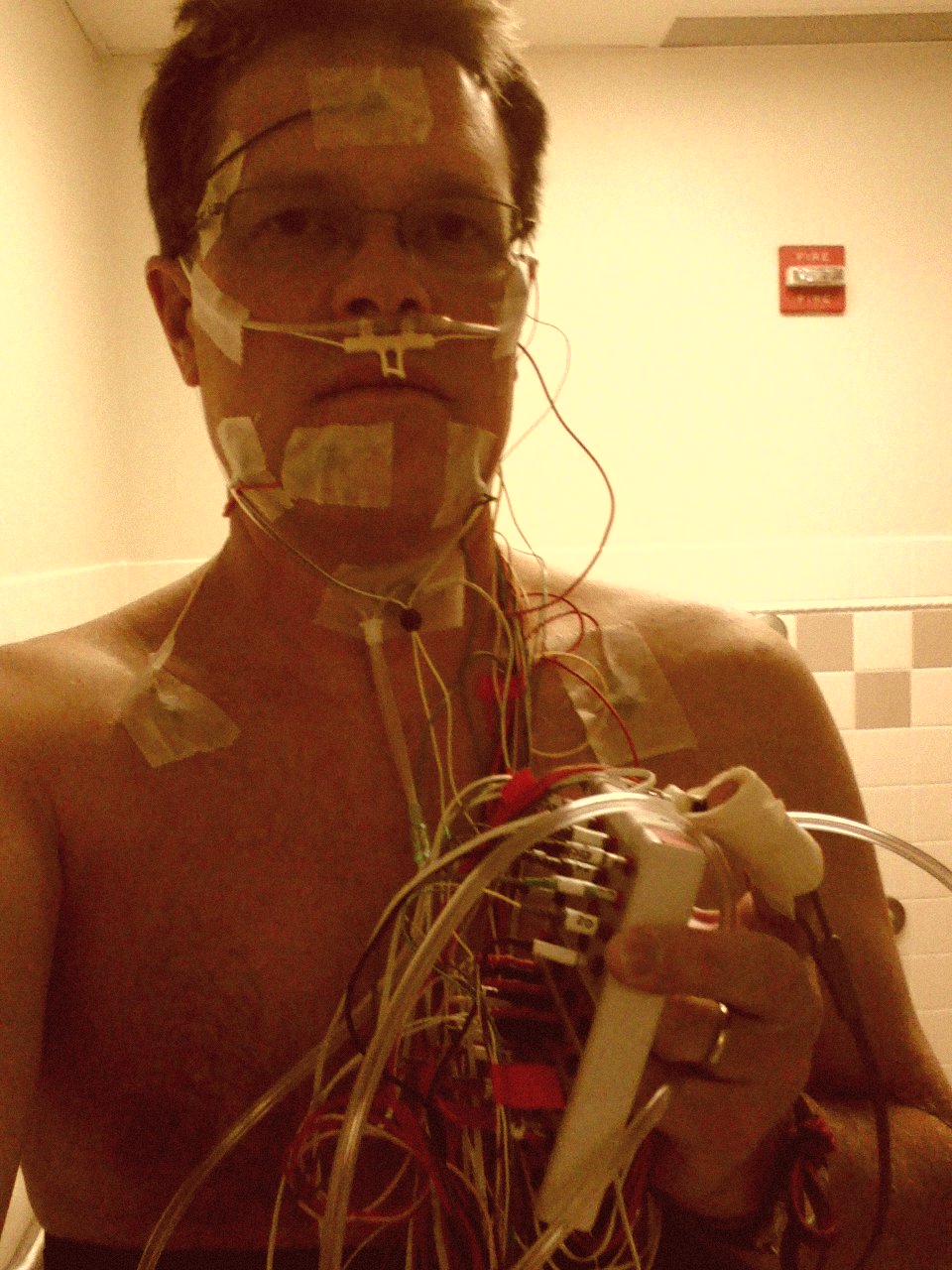
Some words should simply never be placed next to each other.  Two words that I’ll try not to use together are ‘sleep’ and ‘study’.  All in all, undergoing a sleep study wasn’t a horrible experience, per se.  Brutal seems a better adjective.  For one already having issues getting sufficient sleep at night, the idea of glueing ~25 sensors to my head, face, neck, chest, finger and legs with all of the wires from each sensor attached to a “break-out’ box on the headboard of the bed is, well, unnerving.  I mustn’t forget the elastic bands around my chest and stomach and oxygen tube thing that gets placed in your nostrils.  That feels good – NOT! Thankfully a “silver bullet” to monitor core body temperature isn’t required.  Ask a Marine – they’ll know of what I speak.  Suffice it to say, though, it isn’t oral!

Even though the sleep study was done at a medical clinic, the room itself was comfortable enough having the appearance and typical furnishings of a Holiday Inn.  The bed wasn’t uncomfortable.  However, the plastic liner under the sheet felt weird.  I found no Gideon Bible.  However, in its typical place within a nightstand drawer next to the bed was a plastic hospital bed urinal.  I panicked at the thought of being strapped into bed all night unable to move lest “the patient” [me!] twist and turn and break one of those electrodes while trying to use this “special containment vessel”.  Fear gripped me and I had visions of the sleepologist turning out the light and then say with a quiet demur while shutting the door,  “You spill, you die!”

But my fears were quickly allayed when, after I was all wired up, the sleepologist explained how it would be possible, if necessary, for me to get up in the night and use the bathroom.  That was a relief!  Yes, pun intended!

To my dismay, the technician wanted me to sleep on my back.  That was really awkward as I primarily sleep on my side or stomach.  I was able to relax and do a little reading and even watched the end of a baseball game on TV.  Eventually I felt tired enough and thought I was ready to sleep.  If I ever wondered how they were going to “put me to sleep”, now was the time.  I half expected that I would be given some kind of quick acting, short lasting sedative.  Nope.  After you’re in bed and the myriad of wires are attached to the breakout box, the sleepologist turns out the lights.  Then, from the control room via a speaker phone, the sleepologist goes through a series of checks for all the sensors to ensure that everything is working.  After I had moved my eyes in different directions, clenched my teeth, breathed in a couple of times, held my breath, wriggled my legs – she as much said everything looked good and with a pleasant, “good night” – I was on my own.

I had previously been told that there is an infrared camera and microphone to correlate audible snoring sounds and body movements with electrical signals in the brain to better diagnose sleeping anomalies.  It made me want to ask the sleepologist if she’d heard or observed any funny things with her patients?  But I thought it best to keep my dignity to myself in part because I realized that something might happen to me and I might become one of those “stories”.

I opted to keep my watch during the night.  I wanted to know where I was within the “process” – how much longer is this going to last?  In hindsight, this might have been a mistake.  I don’t know.  Still, being wired up and in an unusual position, it was difficult falling asleep.  But I guess I did.  Or, so I was later told.  In fact, the sleepologist told me that my best sleep came after I had initially fallen asleep.  I had remained asleep for perhaps an hour and a half before I woke up.  Thereafter, the sleepologist told me that my sleeping was very erratic and I don’t really know how much sleep I actually got.  Maybe three hours total?  Maybe four?

I woke up for the last time a little before 5am and laid there trying to get some additional sleep.  I felt terrible – almost as though I had a cold; a little stiff and sore and a headache too boot.  At 6am I “rang the bell” and informed the sleepologist that I was done and wanted up.  She agreed and knew I had been just laying there awake for a little over an hour.  Hopefully I hadn’t done anything worthy of a story for her colleagues.  Anyway, she needed to verify that all the electrodes were still functioning so we repeated the pre-sleep tests.  After all the electrodes had been removed, I took a shower, dressed and then filled out a questionnaire regarding patient satisfaction.  The technician had previously informed me that any results would have to be discussed with the doctor in a subsequent follow-up visit.  So, that’s the next step – see what the doctor orders.

I’m certainly not anxious to be diagnosed with a malady that will be alleviated with a CPAP machine.  Then again, I’m tired (literally!) of always seeming to lack energy and dragging myself from one activity to the next whether at work or meeting with friends.  But, we’ll see where this leads.  The symptoms are what they are and the condition is what it is and if using a CPAP will bring relief then we’ll figure out how to do it.

UPDATE:

The doctor’s evaluation of my sleep study is that my sleep is interrupted by something called mild obstruction sleep apnea.  For most people, full and partial airway closures, snoring, and something called “near misses” are more prevalent when sleeping on one’s back than when sleeping on one’s side.  And, such is the case for me.  To that end, a CPAP or even some kind of a dental mouth guard called a mandibular repositioning appliance would help with the breathing and snoring.  However, whether I’m on my back or on my side, there are numerous one-to-three second periods, or as the doctor called them – arousals – that also keep me from getting normal deep sleep and which would not be helped by a CPAP or dental appliance.  These arousals are often related to things like pain, stress, and temperature and it’s not clear (at least to me) that any of these are reasons why I’m waking up.  So, at this point, I’m not sure what to do next.

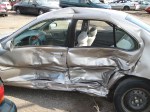
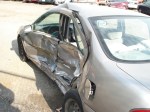
It could have been much, much worse

Thankfully, neither my daughter who was driving this car or the driver of the other vehicle were seriously injured.  However, slightly higher speeds, or the other driver hitting my daughter just a fraction of a second sooner – and the outcome could have been much, much worse.  Cars can be fixed or replaced.  Nothing can replace my daughter.

Winter Garage Sale – Everything Digital Must Go!

It’s been a while since I’ve delved into any Arminian/Calvinist stuff.  Perhaps a break was needed.  Sometimes, however, other things can come to the forefront of one’s life when, as happened yesterday, I had a one-on-one session to learn GarageBand.  I took lots of notes and seemed to understand what to do to fire this program up and start recording only to get home and NOT BE ABLE TO GET IT TO WORK.  This is so frustrating and so typical of my experiences in the digital world.  Perhaps others can relate:

It was bound to happen.  Some folks seem to have a knack for all things digital.  I’m not one of them.  What seems to be exceedingly easy for some people has become a trial and tribulation of biblical proportion for me.  My doctor is not willing to up my medication and I’ve used up the 20 annual psychological counseling sessions per year our medical plan allows (and it’s not even March yet!!).  Therefore, in the interest of sanity and self-preservation, I am offering my fellow bloggers and readers the first crack at:

Digital Equipment Winter Garage Sale

Middle aged male tired of constantly losing to the ‘digital aspects’ of everyday life and being considered dumber than a 5th grader.  As of today (except for the help required to get this memo posted) I’ll be writing with paper and pencil, listening only to AM/FM radio in the car, doing home musical recordings on a cassette tape, talking with others through a landline phone, checking out books from a library, subscribing to a daily newspaper, submitting the 1040 long form via the US Post Office and using a camera that accepts Kodachrome film.

For Sale:

  • Computer preloaded with software – new $1.00 (Half a CD wedged inside.)
  • USB interface – new $0.50 (Squished front panel knob.)
  • 40” flat screen TV – new $5.00 (Orange juice stain on front.)
  • Digital Camera – new $0.10 (Slight thumb depression on side.)
  • DSL router & home wireless system – new $0.25 (Inadvertently hit by pen that cracked the front panel.  All lights still working.)
  • GPS unit – new $0.05 (Regret not buying protection plan against being dropped.)
  • Digital Thermometer – used once $0.01 (Best not used orally.)
  • XM/Sirius Radio – slightly used.  Take over payments.  (Display brighter than an LED flashlight.  Black sock included for nighttime driving.)
  • Guitar effects processor – good condition ($0.75) (May have been inadvertently bounced off wall while unplugging.)
  • DVD player & 5.1 surround system – still in original box $3.00 (Orange juice may have leaked into box.)

Free:

  • Cell phone/MP3 player/camera – new (It’s somewhere along Wilderness Run Road in Eagan, MN.  I’m sure the snow bank it hit cushioned the impact.)

No reasonable offers refused

Trying to Understand Calvinist Thought & Logic Related to the Will of God

This post came about from comments written by myself and two others elsewhere on this blog.  For the sake of clarity and to keep a post on a given topic, I’ve decided to bring those references and comments under a new post.

My previous post on “Calvinitus” was an attempt to show my struggle with Calvinist doctrines infusing themselves and otherwise coloring (maybe blinding?) my perception of God.  However, after recently watching an old movie about Lou Gehrig, Pride of the Yankees (1942), it occurred to me that perhaps Calvinists also struggle with the reality of their own doctrines – particularly unconditional election.

Most people probably associate Lou Gehrig with amyotrophic lateral sclerosis (ALS), often referred to as “Lou Gehrig’s Disease”.  ALS is an insidious progressive neurodegenerative disease affecting the nerve cells in the brain and the spinal cord for which there’s currently no cure.  I have no idea as to what Lou Gehrig’s religious beliefs were.  If I may, however, let’s assume Lou Gehrig was an ardent Calvinist.  There’s a scene from the movie, where Lou Gehrig learns that he has ALS, which goes something like this:

Lou: Give it to me straight, doc.  Is it three strikes?

Doc: Yes, Lou, I’m afraid so.

Lou: Well, I’ve learned something over my life.  You can’t change the call of the umpire.

Calvinists I know believe that God ordains all things.  That being true, then Lou Gehrig’s “Calvinist” example is one of humbling accepting God’s will when he’s diagnosed with ALS because of his realization that “you can’t change the call of [God]”.  Lou further exemplifies his submission to God’s will when he says during his retirement speech, “I consider myself to be the luckiest man on the face of the earth.”

It was interesting, then to find a story (here) where a Calvinist man goes to visit his grandfather in a hospital.  Also present at the hospital are his grandmother and a Eucharist minister.  The Calvinist man is upset that the Eucharist minister is offering his grandparents feel-good prayers, pseudo-repentance and communion.  The Calvinist man was struck by the wretchedness, hostility, false assurance and blasphemy of the Eucharist minister’s actions and his grandparents attitudes toward God.  The story continues that later, and without success, the Calvinist man tries to convey the gospel message to his grandfather.

It surprises me that Calvinists appear blinded by the logic inherent within their own doctrines.  According to the doctrines of total depravity and unconditional election, God determines who will be saved and conversely who will be eternally lost.  Therefore, why is this Calvinist man dismayed at his grandparents or the Eucharist minister?  God hasn’t elected them.  They’re toast.  The Calvinist man understands that no witnessing, no praying, nothing the Calvinist man could do is going to change what God has sovereignty decreed.  As such, I submit that the Calvinist man’s frustrations towards his grandparents and the Eucharist minister are misdirected.  Consider:

  • The Calvinist man believes God has predetermined the decisions his grandparents have made.
  • God, however, has not chosen to save the Calvinist man’s grandparents.
  • The Calvinist man is dismayed that his grandparents are not elect.
  • And, the Calvinist man realizes that because God is in control, there’s nothing he can do.
  • As such aren’t those feelings of loss and separation related to his grandparent’s eternal destiny directly attributable to God’s sovereignty in the matter?
  • The grief the Calvinist man displays would seem (to me at least) to indicate a desire for God to change the inevitable outcome.
  • Therefore, the Calvinist man is in reality opposed to God’s will in this matter.  And if we’re not in favor of some act or condition, then by definition we’re opposed to that very same thing.

What I don’t see from the Calvinist man in this story is the humility exhibited by Lou Gehrig.  Wouldn’t the Calvinist man, if he truly believes in his doctrines, say something to the effect of, “I thank God for his sovereignty and for having blessed me with the greatest grandparents on the face of the earth.  I hope and pray that God may change my grandparent’s attitudes toward himself.  But I willingly accept God’s sovereign will and know that even my grandparent’s eternal separation will bring glory to God if only through his perfect wrath.”

That’s just a story some might argue.  Fair enough – but I think it ties in well to an MSNBC news story (here) of a young Calvinist pastor, Matt Chandler, currently undergoing treatments for brain cancer.  After reading the story, here are the comments I made to my good friend and ardent Calvinist, Mike:

Is there not something incongruous between Matt’s statements versus his actions as related to Calvinist thought and logic regarding the will of God?

“Lord, you gave [me cancer] for a reason.”

[Matt] is praying that God will heal him.

Whatever happens, [Matt] says, is God’s will, and God has his reasons.

As I understand Matt’s statements, he’s as much saying that God ordained him to contract brain cancer.  However, according to Matt, that doesn’t mean waiting for fate to occur.  Rather, it means fighting for his life, and to that end, Matt is undergoing surgery, radiation and chemotherapy.  I hope this question doesn’t come across as belittling.  However, if Matt truly believes God gave him cancer, then why doesn’t Matt have the faith to accept the cancer along with the significant potential of him dying and leaving behind his wife and two young daughters?

From reading the article, I sense Matt believes that God could cure him without all the standard fare of cancer treatments?  Yet, Matt appears to have decided that it’s best to undergo all of the treatments.  Isn’t Matt in essence saying, “Dear Lord, I know that if it’s your will to cure me, I’ll be healed.  No if’s, ands, or or’s about it.  Now, please don’t be angry at my lack of faith – but just in case, I’ll start all these different treatment options because maybe, just maybe, it’s your will that I’ll be healed through one of them.  Okay?”

Honestly, this seems to be more of the thought process Gideon used.  In this case, Matt seems to be hedging his “faith-bet” by putting down sheepskins of surgery, radiation and chemotherapy in order to ensure that all the bases are covered – and all the options for God to use are available .  Is Matt showing his faith?  Or, is Matt showing his desire to live irrespective of what God may have ordained?

With regret, I say that this appears to be somewhat of a false-faith. All the Calvinists know I emphatically emphasize God’s sovereignty and his being in control of everything in our lives.  And yet, when confronting an obvious life-or-death situation such as cancer, I’ve NEVER known anyone who was willing to sit back, praise God for the cancer (or any other serious or life-altering disease) they contracted, and look forward to their death.  Granted, I’ve only known of a few people who’ve dealt with cancer and the like.  But irrespective of the situation or circumstance, no one I know (Calvinists or not) simply allows “God’s will” to occur.  Everyone employs some subtle theological argument that “maybe, just maybe I had better play it safe in case God might be leading in ‘this’ direction.”

By definition then (at least as I see it), this Calvinist pastor is fighting God’s will and in essence trying to wrest control of the end results from God (most likely his death from cancer) by undergoing treatments.  So, I’m curious as to what you think: is Matt is trying to take control away from and/or otherwise alter the sovereign will of God?

Is There Such a Thing As Calvinitis?

I think I have a condition.  I think it’s called Calvinitis.  Hopefully it’s not contagious.   Calvinitis is the inability to read something without becoming cynical of what is actually being said.  Below is a recent letter from our pastor inviting the congregation to participate in small group discussions related to “Extravagant with Love and Abundant in Grace”.  To help my Calvinists friends better understand this condition, I’ve taken the liberty of imparting “Calvinisticals” – a term I just now invented.  Calvinisticals infuse the inherent Calvinist logic and thought that may not be obvious to the majority of Calvinists and non-Calvinists unaffected by Calvinitis.

The word “prodigal” certainly describes the younger son [whom God hated from the beginning of time] who recklessly spent his entire inheritance [because he was unable to choose to follow God] in the blink of an eye [because God willed it to be in order that his perfect wrath might be exalted].  However, in another sense, the word “prodigal” also describes our God [who demonstrates the extent of his love by saving those (the elect) whom he chooses] who is extravagant with love [so long as he has elected you], who is abundant in grace [so long as he has elected you], and who spent everything to make us a part of his family [so long as he has elected you] again [well, provided that you’re part of those contained within the limited atonement of Christ’s blood for the remission of your sins].

We’ve all heard the story of the Prodigal Son before [unless God hasn’t until now ordained that you would even want to be in church].  However, as you join us on this five week sermon [because God’s irresistible grace will overcome all resistance for not wanting to join us on Sunday mornings] and small group series you will find this story come to life in ways that you have never seen before [because God called you into communion with himself and will continue with you in faith until the rapture – or whatever].  To get the most out of this series we [through the blessings of the holy spirit who allows truth to be seen] encourage you to participate in the small group experience [because God controls everything and there’s no free choice in the matter].  If you are not currently in a small group [perhaps as a result of God intentionally keeping you isolated], we have 11 different small groups [that God has specially put into place for us] that are just waiting for you to join them [unless, of course, you’re already doomed].  No matter where you are on your faith journey [it’s because God wants you right where you are to teach you something], this study will challenge and encourage [only so far as God gives you encouragement] you [so that God will be glorified].

Extravagant with Love and Abundant in Grace – [So Long as You’re Elected]

Calvinist Thought Seasoned with Christian Clarity – A Different Perspective

After my little (upheaval) with Christian Clarity Review, I looked for other Calvinist perspectives on the earthquake tragedy in Haiti.  I may find this (post) from (The Lighthearted Calvinist) admitting that God’s sovereign will brought about earthquake to Haiti difficult to accept.   Still, the candor and humility with which it is written is, well, refreshing.  Certainly, within the context of such tragedy, many pointed faith-based questions arise.  Given that there is such a wide variance within Christian thought (irrespective of Christians working from the same “source material”), it is perhaps only natural that some people will construe an event one way while others do so from another perspective.  Nevertheless, arguments can be constructed and disagreements made in such a way as to not be disagreeable.

Calvinist Thought Seasoned with Christian Clarity

A recent blog post (here) started with the comment:

  • Quick: for the preservation of history, count all the Calvinists in Haiti that are looting or how many are in government there.”  Note: A previous post from this site regarding the earthquake in Haiti is (here).

Upon seeing this, my “Calvinometer” radar detector turned “on”.  There’s something about the wording and the overall tone in these posts that strikes me as, well, harsh.  A question came to mind: could the basis for this mindset and interpretation of scripture emanate from the Calvinist doctrine of unconditional election wherein:

  • God intentionally deceives some into a lie.
  • God hasn’t chosen someone to be saved.
  • Therefore, that non-elected person is not worthy of an elected person’s time and effort.
  • Therefore, that non-elected person should just go away, die, and be done with so that those whom God will have with him for all eternity can get about the Lord’s heavenly business and blessings.

I commented on these posts from Christian Clarity Review in essence asking:

  • What’s the point of “piling on” the misery that many Haitians are currently experiencing?
  • How is the love of God portrayed within these posts?
  • Have you no heart to ache for people – even if you believe God brings about calamity?
  • Where in the New Testament does Jesus turns away his love and compassion from the hurting and suffering?

The response I received was, well, surprising.  Regrettably, I misidentified Timothy (my sincere apologies to Charles) in my initial comments to his post on the Haitian earthquake.  Nevertheless, here are some Christian Clarity Review responses to my comments and questions:

  • [Christ haters] [don’t want] to hear God caused the earthquake in Haiti.
  • True Christianity is not at all about picking Christianity over other religions [as one] can’t decide to do so.
  • Jesus Christ went 40 days without food or water.  Moses as well.  [One] gets the impression that a few days without food are a cause for worry and a health-crisis.
  • [The earthquake] is the honesty of what happens to those who hate Jesus Christ and have made open, unapologetic pacts with Satan.
  • You post for political and theological pretense.
  • God sent Haiti the earthquake.  Before that He sent them a deception
  • You want to cover over what God has done.
  • The lie of free will is your bread and butter [and always sucking off your soul].
  • You are a fake Christian and have the spirit of Balaam.
  • I read your response Bozo.
  • [Your] phrasing of etiquette [is] surely a shield to hide the fact you’ve lied about Christ.
  • You put up the emotional shield as if that were a standard part of God’s discourse.
  • I’m absolutely certain God has deceived you.
  • You’ve received more truth than most people [and] have subtly laughed it off.
  • You preach a different gospel in the guise of searching for the pure one.

I don’t doubt that Timothy’s abject starkness and callousness is heart-felt.  I’m not sure why – maybe it’s his mother’s fault!  And I don’t doubt that I may have “tweaked” him with my questions and comments.  But where does Jesus respond to hurting and suffering people in need of a savior in such a way as Timothy does?

First of all, my apologies to Bozo.  I did watch him as a child and can fully attest to everyone that I’m not Bozo.

Timothy stated that God has “sent me a deception” and therefore, it’s impossible for me to see the truth because I have no free-will in this matter.  Yet, Timothy’s responses to posts on this blog (here) and (here) would seem to have indicated that (at least at one time) he thought that there was a potential for me to see the truth (at least the truth as he portends it)?  As such, is Timothy really convinced that God intentionally deceived me?  I don’t think he is.

There were a number of scripture verses Timothy used to justify his stated beliefs.  My understanding of those verses in context is, well, different.  Perhaps I’ll provide my understanding to those verses in the comment section of this post.

So, what is one who admittedly struggles with Calvinism in general and the concept of unconditional election in particular to think about what is contained within Christian Clarity Review?  The truth is, not much.  I have personally experienced a lot of love and grace from proponents of Calvinism (CH, NM, MB, PP, WC and many others).  I am ever grateful to those who will walk alongside, explain, and even question my foundations of faith.  I don’t think I’m elect but (sorry, Timothy) I do believe I am saved (Rom 10:10).  Based on my own ’empirical’ evidence, Timothy’s opinions, writings and ad hock attacks represent a very small percentage of Calvinists.  Still, might there be a logical extension for one to ‘discover’ election and ‘create’ the Calvinist-oriented views as expressed within Christian Clarity Review?  I hope not – but how else is Timothy’s perception explained?  Perhaps those with affinity towards Calvinism are in a better position to state (what I believe to be) the error of Timothy’s approach and methodologies he uses in defending his faith.

Seminaries in the Business of Election

Irrespective of my struggle with Calvinistic thought, I couldn’t help but enjoy a bit of levity when I came across a seminary with “elected faculty”. 

http://www.sebts.edu/academics/faculty/default.aspx

Scroll down the list to find the “appointed faculty”. 

Who knows why, but my kids’ Dr. Seuss book on Sneetches comes to mind – something about those with stars on their bellies and those without stars on their bellies and tying all that in to the doctrine of election.  Whatever. 

Feel free to comment on ‘theme’ verses.  Here are a couple that came to my mind:

  • John 15:16  I [president of SEBTS] have elected you to [teach] at SEBTS and produce [lectures] that will last
  • Heb 9:27  For you’ve been appointed once to [teach] and then to die [or maybe receive job offer]