A Coming Economic Earthquake?

images-3With the “fiscal cliff” looming, I rather like this comparison of the federal budget fiasco currently underway to a typical family budget that a friend recently showed me.

US tax revenue  $2,170,000,000,000
Federal budget  $3,820,000,000,000
New annual debt  $1,650,000,000,000
Existing National debt $16,000,000,000,000
President Obama’s budget cuts          $4,000,000,000

Remove 8 zeros and view this as if it were a regular household budget:

Annual income   $21,700
Money the family spent   $38,200
New debt on credit card   $16,500
Outstanding credit card debt $160,000
Total budget cuts so far          $40

Pathetic.

So, for all the posturing and criticisms going back and forth between Republicans and Democrats, the net affect of the proposed budget cuts (over 10 years, no less!) is negligible to the point of being meaningless.

Well, I’m feeling depressed motivated now. And depressed, too. Perhaps it’s too late to avoid the “coming economic earthquake”. Hey, someone really should write a book with that title. 

Quantitative Analysis of Unconditional Election

An interesting blog post asks whether conditional election or unconditional election has more Biblical basis. The author goes on to state,

One of the most persistent and often divisive issues within Christianity is the debate between the doctrine of unconditional election (often called the doctrine of predestination) and the doctrine of unconditional election (often represented as the doctrine of free will).

Provided within the post is a list of verses that each camp uses to justify their respective positions. I don’t know the origin of this list nor do I believe this list is in any way complete. Still, the author wonders whether a greater number of verses (that, at least for this list) in support of unconditional election lend credence that unconditional election is indeed what the Bible teaches? I’m a numbers guy and do some quantitative analysis on the day job so this thought got my attention. 

However, as I scrolled down the list, I noticed that some verses were listed as supporting both predestination and free will. I certainly don’t think it accurate to derive “truth” from just a verse and I don’t think that is necessarily intended here. Context is everything and as such, any given verse must be read within the context of the passage. That said, if something is “truth” in one passage, then doesn’t there have to be commonality of that “truth” throughout all of the Bible?

Jesus says the truth will set me free (John 8:32). Perhaps my struggle regarding unconditional election can only mean that I don’t know the truth. Of course, preceding vs 32 is vs 31 where Jesus says if I hold to his teachings then I am really his disciple. Perhaps therein lies the issue – I’m not his disciple. Therefore, I can’t know the truth. Hence, I struggle in my faith – and not just with unconditional election. Perhaps I’m beginning to overanalyze – time to chill-out.

Anyway, I’ve come across this before – Calvinists and Arminians using the same verses and passages to to defend (or argue against) unconditional election. Romans chapter nine is perhaps the best example I know of. That the likes of John Piper and Greg Boyd have diametrically opposed perspectives of this chapter is troubling to me. But I understand that not all Christians are bothered by, what I can only call, the “variance” of Christian thought at least with respect to unconditional election.

In any event – to the question: does a greater number of verses supporting one perspective help to sway or otherwise bring about resolution within the Calvinist-Arminian argument? Probably not. But, what do I know?


Declaring Intangible Religious Benefits

I’m filing stacks of paper that have surrounded my desk and noticed an odd disclaimer on our church’s quarterly giving statement. It said, 

[This] Church provided no goods or services in return for these contributions except intangible religious benefits.

So, just what is an intangible religious benefit? This phrase was on the last giving statement as well. I didn’t notice it at the time – but that’s not the first time I’ve missed something blatantly in front of my eyes. That said, this phrase nor anything similar was on any giving statements from 2010 or 2011. I’m not aware of any attorneys who attend this church. My mind wonders – who got to the senior pastor and advised him to put such a disclaimer on a giving statement? Is there now a legal requirement for churches to provide such a disclaimer? Are we living in such a screwed-up politically correct separation of church & state et al legalistic society that a church’s giving statement to its congregants must state the obvious? Or, am I missing something? I’m able to apply my church offering towards all charitable giving for tax purposes. Maybe there’s some sort of VAT (value added tax) coming that will offset the deduction? 

Would Esther Have Been Considered a Calvinist?

Recently I pondered whether delving into the Old Testament Torah would help bring about some understanding to Calvinistic/sovereign grace issues within my own faith. Unbeknownst to me, my bride has been studying the book Esther in a women’s Bible study. She’s well aware of my consternation regarding Reformed theology in general and unconditional election in particular. She believes a sovereign God can, and does, direct the events in the lives of believers – and for that matter, non-believers as well. With her permission, I have copied her summary of the book of Esther and how this book has helped to bring about a new sense of purpose and understanding within her own life. 

Can everything that happens in the book of Esther be explained by naturally-occurring events?

    • The king can’t sleep one night and asks the archives of his kingdom to be read to him – which happened to be of the time Mordecai reported a coup against the king and was never rewarded for it.
    • The king is invited to a dinner by Esther.
    • Esther rose to be queen based on her beauty and personality. 
    • The king sees someone in the courtyard which happens to be Haman.  
    • A prideful Haman gives the king a grandiose idea of how to honor someone – the honor Haman actually wishes to have bestowed upon himself. 
    • Haman just happens to be “falling on the queen’s couch” when the king reenters the room. 
    • The king makes a decisive decision to have Haman executed. 
    • A newly built gallows had just been built by Haman which had been intended to hang Mordecai. 

Is it all just happenstance? It seems impossible that all of those events, taken together,  could randomly have lined up that way. It appears that everything was orchestrated and planned out. And none of the players could possibly have seen, understood or even imagined that each event had been specifically designed. 

Is there a lesson for us? Does God work this way in our lives? How do we know if God orchestrates circumstances in our lives today? The book of Esther teaches that God can use people to bring about events he desires – even through people who don’t acknowledge or worship him. The book of Esther also shows God’s heart and compassion for his people. God has good intentions toward us and the power to orchestrate human events in our favor. I believe God has the power to answer my prayers, the power to influence my mind and help me make wise decisions.

Did God orchestrate the approval process at Hamline so that I would enter their education program? Does God specifically want me to be a reading teacher? I still can’t answer these questions with 100% assurance. However, I think it’s much easier looking back over time at events to see a plan and that’s why it’s so evident in the book of Esther that there was a plan. We are looking back over time. No one in the story saw the plan as it was unfolding. The book of Esther teaches that God sees and cares and works on behalf of his people. May we trust in God’s good intentions and his providence over our lives. 

Romans 8:38-39 states, “For I am convinced that neither death nor life, neither angels nor demons, neither the present nor the future, nor any powers, neither height nor depth, nor anything else in all creation, will be able to separate us from the love of God that is in Christ Jesus our Lord.”

I’m not sure it really means anything, per se, but I find it interesting that I’ve never come across any Calvinistic reference pertaining to God exercising his sovereignty within the Book of Esther. Still, it’s hard to argue against the “lessons” of Esther that my better 7/8ths elaborated on in her journal. And, it’s hard to argue against those passages in scripture in which God takes an active role or against those individuals specifically called out by God – including Moses, Abraham, David, the disciples, Paul, et al. I don’t doubt that God, being God, can do as he pleases. That said, I’m not a “determinist” and as such am not convinced that God directs the actions and activities of each and every “free agent” (a philosophical term I seem to be coming across more often). Nevertheless, perhaps it is only through the long lens of time that we can understand the path on which we’ve walked and how all that we have encountered on that path has indeed, per Rom 8:28, worked together for the good of those who love God and have been called according to his purpose. 

The Hope of Arminianism?

ArminianApparently, and for the 2nd time, a comment I’ve made in response to a blog post hasn’t been accepted. Sorry, I don’t mean to offend. And, I guess I can take a hint. Again, given that my response wasn’t accepted, I thought it permissible to share my $0.02 and ask my questions here. It is, after all, my blog. ☺

Overall theme from what was initially blogged:

Arminianism allows that Christ died for all men. Given that some are in hell for whom Christ died, there must be a deficiency within Arminian doctrine as to the certainty and assurance of the Arminian’s salvation because of a mutable God being outwitted by Satan.

My response:

Wow! Could it be possible that there are honest Scriptural differences, interpretations or even misunderstandings that Arminians have related to the nature and character of God and the Calvinist doctrine of unconditional election?

Simply put, whether Calvinist, Arminian, Open Theist, Catholic, a retired Presbyterian minister or whatever – if one by faith accepts Christ’s sacrifice for their sins and proclaims Him as Savior, is that person saved?

Bluntly put, can one reject the Reformed doctrine of unconditional election and still be saved?

I’ve got a good sense what this particular Calvinist would say. But I’m curious as to other Calvinist’s opinions: is my salvation predicated on an acceptance of the Reformed doctrine of unconditional election?

Eph 1:4 – Does It Really Support Unconditional Election?

For He chose us in him before the creation of the world to be holy and blameless in his sight.

Anyone delving into the doctrine of unconditional election has certainly come across Eph 1:4. I’ve had this verse tossed my way a number of times to “prove” that God really is the one choosing the elect. My Calvinist friends will chide me that I’m not be able to see the forest through the trees because, after all, there it is in plain “NIV” English – He chose us. What is there to not understand?

Fair enough. However, what if we were to read the verse without the prepositional phrases? After all, what is a preposition but a word that links nouns, pronouns and phrases to other words in a sentence. 

Some simple examples of prepositions: The book is ON the table. The book is BESIDE the table. He read the book BEFORE class.

In the above sentences, the highlighted prepositions locate the book in space or time and provide a logical relationship of the book to the rest of the sentence. Certainly, if prepositional phrases are removed, then the intent and meaning of a sentence can be lost – as can easily be understood in the above examples. Regarding Eph 1:4, however, it appears to me that the intent of the verse remains the same with the prepositional phrases removed:

(For) He chose us (in Him) (before the creation) (of the world) to be holy and blameless (in His sight).

Without the prepositions, then, Eph 1:4 says; He chose us to be holy and blameless. The long and short of it, then, is that Eph 1:4 appears to have nothing to do with divine selection of individuals unto salvation. This is even more readily understood when I look up the word “chose” in my Webster’s dictionary and see different meanings including: “to select freely and after consideration” and “to decide”.  For reasons beyond my language skills, the authors of the NIV Bible selected the English word “chose” when translating Eph 1:4 from Greek to English for a reason –  “chose” is the best translatable English word. I readily accept that. 

Therefore, using Webster’s common English understandings for the word “chose”, I believe a fair interpretation of this verse is that God decided that we were to be holy and blameless before He created the world

Hence, it seems to me that Eph 1:4 is not a verse that Calvinists can reasonably use to defend the doctrine of unconditional election.


Is John 3:16 The Most Misunderstood Verse in the Bible?

Well, apparently so according to a post I recently came across (see source below). A comment I wrote in response wasn’t accepted and so I thought it okay to share my $0.02 here. 

What was initially blogged:

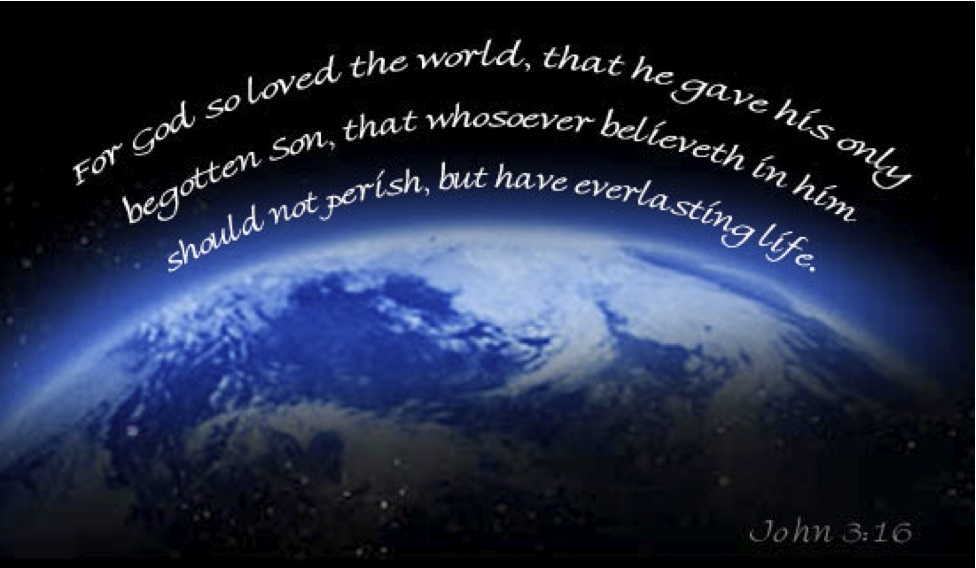
“For God so loved the world that He gave His only begotten Son, that whosoever believeth in Him should not perish, but have everlasting life.”
(John 3:16)

This is perhaps the most oft-quoted, and least understood verse in the Bible.

This verse is used by many to teach that God loves all men the same, has provided salvation for all men the same, and it is up to man to do something with it.

This verse teaches no such thing!

The emphasis in this verse is not the quantity of God’s love, but the quality!

Whether the whosoever refers to one man, or one billion men, it has no bearing on the meaning.

If only one person was converted by this Gospel, it would not be any less glorious than if one billion people were converted by it.

The point of wonder is “God so loved the world…..that He gave…..His only Begotten Son…..that whosoever…..believeth in Him…..should not perish.”

My Response:

I don’t disagree that there is any sort of numerical value placed upon or within this verse such that the “whoever” refers to one person or all of the world’s population since the beginning of time – or for that matter any number in between.

However, it’s with interest that the definition of “whoever” in (what is for me) my trusty Webster’s Ninth New Collegiate Dictionary actually means, “whatever person: no matter who”. With respect, I can’t help but sense that the plain text language of John 3:16 really does mean that God so loved the world that whatever person (i.e. no matter who) believes will have eternal life. To infer anything else here is, I believe, beyond the plain text of this verse and, I think, the context of this passage. To that end, if John 3:16 was the only verse in the Bible, I’m hard-pressed to believe that there would sufficient evidence to support the doctrine of election. This to me, then, is a reasonable indication that this verse doesn’t necessarily support the doctrine of unconditional election. As a non-Calvinist, I struggle with a lot of other verses regarding things such as predestination and election. However, John 3:16 isn’t one of those verses.

Source: http://justifiedbychristalone.com/2012/02/13/the-most-misunderstood-verse-in-the-bible/

It’s a John 3:16 Mud Fight!

I made a feeble attempt in my previous post to incorporate some simple algebraic logic to help understand the wording of John 3:16 and whether or not Jesus is directing his words to “whoever” i.e. everybody or only those chosen by God for salvation (the elect). It seems more plausible (at least in my own understanding) that Jesus is inferring everybody and to that end I readily admit I’m biased against the Calvinist doctrine of unconditional election. 

Trying to dig up some additional information, I looked through my copy of, Debating Calvinism {five points, two views} by Dave Hunt & James White and was surprised to not find any references to John 3:16. Unfortunately, there are no scriptural references listed at the back of the book. So, if the verse is somewhere in the book, I missed it. Anyway, I did a Google search using [John 3:16 “Dave Hunt” “James White”]. Lo and behold, the first two links provide piles of ammunition for both sides of the argument which in some way only seems to add to the confusion rather than sort out, as it were, the wheat from the chaff. It’s also apparent that Hunt and White have been arguing back and forth for quite some time and there appears to be no love lost between them. In any event, it’ll take me some time to work through each of their letters – particularly James White’s as his delves deep into the Greek. If others are so inclined, below are URLs and a “teaser” paragraph.

From Dave Hunt: http://www.thebereancall.org/calbook.htm You go to great lengths to explain John 3:16 as no child could ever understand it. By your standard, not until they become “scholars” expert in Greek (or take some Calvinist’s word for it) will they recognize that Christ didn’t die for the whole world, but that salvation is offered only to an exclusive elect to which, by overwhelming odds, they most likely do not belong, being part of the vast multitude of the damned on the “broad road to destruction.” Eternal doom awaits them simply because the God who “is love,” from eternity past before they were born was “pleased” to predestine them to everlasting suffering with no hope of escape even though the merit of Christ’s shed blood is infinite.

From James White: http://vintage.aomin.org/DHOpenLetter.html It is your tradition to interpret John 3:16 in a particular fashion. That tradition includes two very important elements: 1) the idea that “world” means every single individual person, so that God loves each person equally (resulting in a denial of any particularity in God’s love, even in His redemptive love), and 2) that the term “whosoever” includes within its meaning a denial of particularity or election.

So, “God so Loved the World” Only Refers to The Elect?

A week or so ago I had to set the alarm to 4:00am. Truly, I’m not a morning person and getting up this early was painful. The radio was tuned to a Minneapolis radio station, KKMS (980AM). As I was laying in bed half-awake trying to get my eyes to focus, I realized someone was saying that John 3:16 – where Jesus says, for God so loved the world – doesn’t refer to everyone in the world. Rather, according to Dr. Steven Lawson (of whom I’m not familiar), this passage pertains only to those persons whom God chooses (the elect) to save. Well, this got my adrenalin going. I was immediately awake and listening intently. Unfortunately, without paper and pencil and with my bride beginning to stir, I wasn’t able to jot down any notes. Dr. Lawson stated that there are a dozen meanings for the Greek word Cosmos (sp?). I’ve listed those definitions I can recall along with the supporting scriptural references:

The entire universe (John 1:29)

The physical world (John 13:1)

Humanity minus believers (John 7:7)

Large group

Non elect

Elect only

As such, Dr. Lawson contends we need to exercise caution in interpreting John’s use of the word “world”.

I’ve been unsuccessful finding out what, according to Dr. Lawson, are the other interpretations for the word “the world” and getting some additional details of this sermon. In any event, I’ve experienced before that what appears to be to be a plain text passage in the Bible is often interpreted quite differently by my Calvinist friends. But this is the first time that I’ve come across the word “world” in John 3:16 not referring to all of humanity.

To me, John 3:16 (at least in the NIV) is pretty easy to understand: For God so loved the world that he gave is one and only Son, that whoever believes in him shall not perish but have eternal life. It’s certainly a fair point of argument if the word “the world” in the context of the passage implied something other than every person. But I don’t think that is the case here.

To help me better understand Dr. Lawson’s contention that John 3:16 is only for the elect, I replaced the words “world”, “whoever”, “everyone” etc with “the elect” or some Calvinistic equivalent. I’ve been chastised for doing similar things before because I’m “twisting” scripture in order to reach a desired conclusion. Well, that’s not my intent. Rather, I find it a useful exercise to help me understand whether or not the logic of an argument (in this case, whether “world” represents everybody or only the elect) makes sense. In chapter three, Jesus is speaking to Nicodemus. The Calvinistic “twist” that follows doesn’t seem to make sense to me:

(14) Just as Moses lifted up the snake in the desert so the Son of Man must be lifted up,

(15) That [the elect] who believe in him may have eternal life

(16) For God so loved [the elect] that he gave his one and only Son, that [the elect person] believ[ing] in him shall not perish but have eternal life.

(17) For God did not send his son [to the elect] to condemn [the elect] but to save [the elect] through him.

(18) [Whichever elect person] believes in him is not condemned, but [whichever elect person] does not believe stands condemned already because [that elect person] has not believed in the name of God’s one and only Son.

(19) This is the verdict: Light has come [to the elect], but [the non-elect] loved darkness instead of light because [the non-elect’s] deeds were evil.

(20) [Everyone who does evil hates the light, and will not come into the light for fear that [their deeds will be exposed.

(21) But [whoever] lives by the truth comes into the light, so that it may be seen plainly that what [he] has done has been done through God.

For me, verse 18 appears most problematic. Jesus says whoever believes is not condemned and whoever does not believe is condemned. This seems pretty straight-forward to which my Calvinist friends would say that God saves those he wishes to save and to those God wishes to save he gives the ability to believe. However, it’s the same word in the verse- whoever. And there is significant tension when I insert “the elect” for “whoever”. [The elect person who] believes in Jesus is not condemned, but [the elect person who] does not believe stands condemned already because [that elect person] has not believed in the name of God’s one and only Son. According to what I know and understand about Calvinism, there’s no such thing as an elect person not believing.

Therefore, in my simplistic reasoning, if one doesn’t accept that “the world” in this passage doesn’t refer to everyone (i.e. all of humanity) there have to be significant linguistic gymnastics to overcome (what I think is) the obvious and plain context of the passage And I have to wonder, whether Dr. Lawson (and all Calvinists for that matter) find it necessary to alter the clear verbiage of scripture in order to more closely follow a system of belief i.e unconditional election? 

Studying the Torah to Move Beyond my Calvinist Divide?

It’s been nearly a year since I’ve posted anything much less done anything to move beyond my “Calvinist Divide”. To be honest, nothing has really changed. I’ve done precious little to resolve my faith conflicts. Perhaps I’ve been on an unintended sabbatical. I wish I had something to share, something to show – but I don’t. Recently, however, a friend suggested I put some time and effort into the Torah. My first thought was, “Oh please! Why waste my time learning about Jewish doctrine et al? I’m under grace and not the law and as such, what’s the point of delving into the Old Testament?”

Nevertheless, perhaps there is something to be said at looking at the root of Christianity – which I do believe is founded in the Old Testament. Of course, I look at the Old Testament as “Latin” – and why do I need that when I’m fluent in English – and even have Webster’s Ninth New Collegiate Dictionary when I come across a word I don’t know? In any event, I’m intrigued by the gentleness and confidence of my friend and think that just maybe there is indeed something to the study of The Torah for a Christian. So, we’ll see.

Below is an email I sent to the reference I was given. 

Dear _____,

A friend has referred me to you saying that “[you have] taught us through the Torah study to look at scripture through the lens of our God being good and for life. With that lens you read every thing from a new perspective. The Torah study also gave new depth to the new testament when you realized that [the] Torah was the root and base that the new was grafted into.”

I’m one who’s struggled for years trying to understand the nature and character of God and how he relates to us as his creation. The center of my struggle, at least so far as I can determine, is what I call the Calvinist divide. It wasn’t all that long ago that I ran headlong into Calvinist doctrine through my son-in-law. Shortly thereafter I lost all sense of an assurance of salvation. Suffice it to say that I believe Christ paid for my sin on the cross. However, I couldn’t determine whether or not I was one of the “elect” or whether I had come to this understanding of my own accord. And, this Calvinist divide not only affects my assurance of salvation, it also affects who I perceive God to be and how he interacts with his creation. 

Perhaps I’m too logical and pragmatic to live a life of faith. I’ve always thought of scripture as, if you’ll permit me, sort of a “periodic table”. That is, I can know various things i.e. the number of electrons in a valence band, the mass of an atom, etc. Yet, I’m finding it increasingly difficult to know the truth about God through scripture. Perhaps the books on my shelf testify to that: Divine Foreknowledge: Four Views, Four Views on Divine Providence, Debating Calvinism (Hunt & White), Across the Spectrum, and my two favorites for book (and author) bashing – Is God Really in Control? (Bridges) // Is God to Blame? (Boyd)

Honestly, what am I to believe when opposing perspectives are (at least to me) convincingly presented – using the same scripture references? To me, it shouldn’t be difficult for people of average intelligence through their own study of scripture to come to the same conclusions regarding matters of faith. We all work from the same text, don’t we? Or, so I think we all work from the same text. How is it if people with a PhD in theology (i.e. John Piper and Greg Boyd) can’t agree on matters of faith, how am I ever to know what is the truth – unless, of course, I simply “choose” what tenants or facets of faith I want to agree with and leave it at that? 

In any event, I have never spent any time in the Old Testament, in part, because I don’t really think it applies to us. We’re no longer under the law. Instead, we live under grace. Or so I’ve been taught and so I believe. Gee, I guess I’m guilty of “choosing” what I will believe. That said, perhaps there is something to the study of scripture through the lens of the Torah and any thoughts you have or references you could provide would be appreciated.

Sincerely,

Bob