
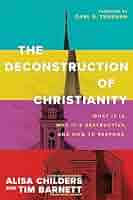
Perhaps there’s more to know. However, after listening to some of Childer’s podcasts and interviews on deconstruction, I’m struck that the elephant in the room has not been brought up. Consider: given a math problem, everyone will come up with the same answer. However, given a Bible verse and/or passage, Christians will come up with a myriad of answers and understandings. Why is this? I submit that Childers and Barnett in their videos have missed a significant reason as to why many deconstruct from Christian faith.
As I’m sure was the case when Paul was out and about on his missionary journeys sending various letters to different churches, people then, as they apparently do now, had difficulty understanding what was written, what it meant and how should these teachings be applied. Hence, lots of different “camps” – be they different denominations or other Christian entities continually pop up. And, by and large, I sense that many Christians congregate into those fellowships that they “feel” (aka – believe) are correct. For instance, many Christians today coalesce within Reformed (Calvinistic) doctrines wherein it is God who has already determined who will receive eternal salvation. Arminians take the perspective that individuals choose of their own volition to accept Christ’s atonement for the remission of sin. Then there are Open Theists who don’t believe that God necessarily knows what will take place in the future. Some advocate for Lordship Salvation wherein God is ‘Lord’ of all within the believer – and if not, he is ‘Lord’ of nothing at all. Is it not obvious the impossibility of the Calvinist and Arminian perspectives to find a happy middle point?
My point, so many people with advanced degrees in theology and are knowledgeable in the languages, history and culture of the Bible come to significantly different conclusions. This can only confirm the difficulties of extracting ‘the truth’ from the Bible. That there is such division amongst Christians as to what ought to be considered primary Christian doctrines such as providence, foreknowledge, the human condition, salvation, sanctification, eternal security, baptism, the notion of Hell, and even women in ministry allows people to derive ‘their own truths.’ Hence, when one takes a doctrinal position and someone else disagrees because they each have ‘their own truth,’ then just where is the way, the truth and the life?
This begs the question: does Christian truth even exist? Do Christians, in essence, ‘make believe’ in their faith – whether it is right, wrong, good, bad or indifferent? Could it be that those who have deconstructed from Christian faith have done so in part because the Christian faith they partook of and believed in did not hold up to scrutiny and turned out to be a myth?

 Martin's Mercurial Musings