John Kasich: Now Looking for a New Purpose in Life

kasichA lot of politicians end speeches with ‘God bless America’ and other similar sentiments. However, when John Kasich, after suspending his presidential campaign stated that his faith is renewed and deeper (I presume from the experience of running for president) and that the Lord will show him “the way forward to fulfill the purpose of his life” – well, my eyes started rolling.

From this statement, I can only presume that Kasich got into the presidential race because he felt God leading him. To which, is Kasich is a godwillian – one who believes that whatever happens, God desires it to be and brought it about?

As an example, John Piper is a godwillian because he’s quoted in Is God to Blame (pg 48) as saying: “From the smallest thing to the greatest thing, good and evil, happy and sad, pagan and Christian, pain and pleasure – God governs them all for His wise and just and good purpose.”

Okay, so let me see if I understand Kasich’s logic:

You felt led by God to run for president.

God has now led you to stop running for president.

I can only assume that you must have thought that it was God’s purpose for your life was to be president. But now, for whatever reason, things have changed.

And for the time being, you’ll wait until the Lord reveals his direction on how to fulfill the purpose of your life.

If I were to take Piper’s logic to it’s logical conclusion, it must be that God is about to choose between Donald Trump and Hillary Clinton to be this nations’ president. Ah, yeah. I’ll believe that when I see Piper praise God for legalizing abortion. Hey, “God governs them all for his wise and just and good purpose”.

And, I guess we’ll now see where God leads Mr. Kasich. 

Divine Sovereignty + Personal Responsibility = Calvinistic Salvation?

divine-sovereigntyA recent comment from a Calvinist friend caused me to pause:

“Our salvation is a combination of divine sovereignty and our responsibility.”

Hmmm. That doesn’t sound like irresistible grace as advocated by ardent Calvinists i.e.:

http://www.calvinistcorner.com/tulip.htm

When God calls his elect into salvation, they cannot resist (emphasis mine). God offers to all people the gospel message. This is called the external call. But to the elect, God extends an internal call and it cannot be resisted (emphasis mine).

So, when I asked my friend if he accepts Calvin’s teaching on irresistible grace, he responded:

Yes, but [I’d refer to it as] initial sanctification based on 2 Thess 2:13; 1 Peter 1:1-2; Gal 1:11-17, Acts 16:14. Could Lydia have responded if God didn’t open her heart? The rub is that [God does this] only for the elect.

To me, all of Calvinism rises or falls on unconditional election. Irresistible grace, along with the other parts of TULIP raise secondary questions. But with my interest piqued as to something new relating to irresistible grace, I looked at the provided references. My $0.02 worth follows:

2 Thess 2:13

But we ought always to thank God for you, brothers loved by the Lord, because from the beginning God chose (emphasis mine) you to be saved through (emphasis mine) the sanctifying work of the Spirit and through (emphasis mine) belief in the truth.

Three key elements:

  • God chose you to be saved
  • Through the sanctifying work of the Spirit
  • And through belief

Chose is obviously the past tense of the word choose and per Webster’s Ninth New Collegiate Dictionary (c1983) means to select freely or to decide on. The way I understand this verse (and many similar verses i.e. Eph 1:4) is that God decided (past tense) that salvation would come through a two-fold process:

1) The sanctifying work of the spirit

2) Belief in the truth

As such, God decided the manner in which we would receive salvation and initiated a “two-part” plan wherein (1 – his part) God cleanses us of our sins and (2 – our part) is to simply believe. Therefore, election, simply put, is conditional on faith in Christ. That is, we’re “chosen” because we already have faith and believe. I don’t see this verse advocating God predetermining from the “foundations of the earth” who would be saved, and correspondingly, who would not be saved. To which, I recognize our responsibility to believe. However, I don’t see this verse supporting irresistible grace.

1 Pet 1:1-2

Peter, an apostle of Jesus Christ, to God’s elect, exiles scattered throughout the provinces of Pontus, Galatia, Cappadocia, Asia and Bithynia, 2 who have been chosen according to the foreknowledge of God (emphasis mine) the Father, through the sanctifying work of the Spirit, to be obedient to Jesus Christ and sprinkled with his blood: Grace and peace be yours in abundance.

Lots of little “catch-phrases” and questions arise: Who are the elect? Who has been chosen? What is the foreknowledge of God? What is the sanctifying work of the Spirit?

1st Peter clearly says, “Who have been chosen.” However, what follows is vitally important – “According to the foreknowledge of God.” I would argue that God, being omniscient, knows in advance who’ll accept his grace. It seems to me, therefore, that Calvinists confuse foreknowledge with predestination and subsequently believe that God decrees and otherwise determines whatever happens. To Calvinists, then, foreknowledge is God’s decree. I believe Romans 8:28-29 confirms my thoughts on this matter:

And we know that in all things God works for good of those who love him and have been called, according to his purpose. For whom God foreknew, (emphasis mine) he also predestined (after they accepted by faith – my interpretation) to be conformed to the likeness of His Son, that He might be the firstborn among many brothers.

God set up his plan. And for those individuals who would receive his grace by faith, God had already determined that they would be conformed to the likeness of his son. Simply put, God knows the future. Therefore, God knows who will believe in Jesus. Those folks (the believers) are the elected individuals. I would submit that God’s election is because of his foreknowledge of who would come to believe and not the cause of it. Again, I recognize and agree that we have a responsibility to believe. However, I don’t see this verse supporting irresistible grace.

Gal 1:11-17

11 I want you to know, brothers and sisters, that the gospel I preached is not of human origin. 12 I did not receive it from any man, nor was I taught it; rather, I received it by revelation (emphasis mine) from Jesus Christ. 13 For you have heard of my previous way of life in Judaism, how intensely I persecuted the church of God and tried to destroy it. 14 I was advancing in Judaism beyond many of my own age among my people and was extremely zealous for the traditions of my fathers. 15 But when God, who set me apart from my mother’s womb and called me by his grace, was pleased 16 to reveal his Son in me so that I might preach him among the Gentiles, my immediate response was not to consult any human being. 17 I did not go up to Jerusalem to see those who were apostles before I was, but I went into Arabia. Later I returned to Damascus.

Many Calvinists have used these verses to justify their belief in a predetermined election. Part of the continuing struggle I have with Calvinism is that many people have many different interpretations. Unfortunately, to a degree, arguments can often get reduced to ‘opinions’. And for me, my opinion is that the phrase, “I received [the gospel] by revelations”, to me, underscores one’s free will as to spiritual things wherein Paul 1) was told about the gospel, 2) Believed the gospel and then 3) accepted the gospel. And again, I recognize our responsibility to believe. But again, I don’t see this verse supporting irresistible grace.

Acts 16:14

One of those listening was a woman from the city of Thyatira named Lydia, a dealer in purple cloth. She was a worshiper of God. The Lord opened her heart to respond to Paul’s message.

Bob George, author of Classic Christianity has stated that the same sun which hardens clay also softens wax. Some people’s hearts become tender and turn towards God while those with hearts of stone turn away from God. I believe God’s Spirit is at work in all peoples’ hearts trying to soften them to acknowledge him and walk in his ways. Perhaps some would call this “prevenient grace”. In that light, Lydia was already a worshiper of God and, I would guess, a keeper of the law. Subsequently, as she came to a full understanding of God’s grace and forgiveness through Christ, the Lord was able to do an amazing work.

With the Holy Spirit moving in the lives of all people, trying to prepare their hearts to receive the gospel and inherit eternal life, it seems apparent that there’re times when God sees those hell-bent on their own abject defiance and rejection of him to the point that God withdraws his Spirit (in reaction to the individuals defiance) and hardens those hearts by giving them up to their own desires (Rom 1:26). Pharaoh is an example that immediately comes to mind.

Similarly, then, John 10:26-27 doesn’t infer that from the “foundation of the world” some were “his sheep” meaning that God had already determined who was to be saved. Rather, Jesus was saying that at that specific time, some were “his sheep” because they believed. Others, who didn’t believe, were therefore “not his sheep”.

As people submit, their hearts and minds are opened to the truth. (2 Cor 3:16) Whenever anyone turns to the Lord the veil is taken away. Coming to Christ is a process. Some have more tender and receptive hearts. For others, difficult experiences and circumstances may help to soften a heart. Unfortunately, there are those who will never accept God’s grace. Much as our lives are transformed after we believe (2 Cor 3:18), “And we [with unveiled faces] are being transformed into his image.” To which, I recognize our responsibility to believe, but do not see Gal 1:11-17 as supporting irresistible grace.

So, to bring this to a close – although I find it sometimes difficult to effectively argue against Calvinist doctrines, I remain unconvinced in a predetermined election as well as the concept of irresistible grace. The verses listed above don’t convince me otherwise. Much of my fundamental disagreement to Calvinist doctrine relates to definitions and implied meanings of words. Or, put another way – opinions. And, too, I can’t fathom a holy God determining who will (and also who will not) be saved any more than I can intentionally ‘cast off’ one of my own kids. The story of the prodigal son comes to mind and I believe that we, as his creation, do have free will. And whenever we, of our own volition, turn to God, he rejoices.

Knowing God’s Will (Finding Guidance for Personal Decisions) by M. Blaine Smith

blaine-smithA number of years ago I read Garry Friesen’s book, Decision Making and the Will of God and found it incredibly liberating. No longer did I have to seek, as Friesen calls it, “the dot” – or “the center of God’s will”. In part, the “traditional approach” to seeking God’s will was ever troubling to me if for no other reason than there seemed to be as many ways to seek God’s will as there were people seeking God’s will. Friesen’s approach to use wisdom in guiding decision-making, although perhaps not as “spiritual-sounding”, is obviously more pragmatic and, to me, logical. Friesen’s “methodology” intuitively made more sense.

With that in mind, I was recently given a copy of M. Blaine Smith’s book, Finding God’s Will, in which there’s an appendix challenging Friesen’s premise. There appears to be a subtle jab at Friesen when Smith writes,

Christians are more inclined to raise questions [as to whether or not the notion of God’s personal will for every believer] is an elaborate straw man than they were when I wrote [Knowing God’s Will] [because] Friesen’s [book] was published about a year after my own book.

Is Smith upset at having lost revenue from reduced book sales? Or perhaps Smith is frustrated with more people comparing and contrasting both books? Maybe both?

In any event, Smith’s critique of Friesen’s Decision Making at best seems muted when Smith himself states [pg 239],

I agree [with Friesen’s] biblical analysis – especially [Friesen’s] observation that Christians in New Testament times generally made their decisions through a rational process.

Smith, however, clarifies his own belief that the early Christians’ “rational process” gives testimony to the way they went about discovering God’s specific and personal will. So far as I can determine, nowhere within Scripture is there a defined “process” indicating how believers should go about finding God’s personal and specific will. Honestly, many folks seem to make the stuff up as they go – selectively pulling individual verses that may lend themselves to some semblance of a “process”. This is unfortunate as in my opinion believers of a personal will of God are making the Bible teach something that the Bible doesn’t actually teach.

Smith states, [pg 238]

Scripture gives us the basis for embracing the full level of human freedom in decision making [without] letting go of the cherished concept (emphasis mine) of a personal will of God.

Honestly, if a book dedicated to knowing God’s specific will and finding guidance for personal decisions can be distilled down to a “cherished concept”, then the author lacks the conviction of what he’s put forth in the 248 pages of this book.

Smith writes in numerous places as to an “individual will” in God’s guidance all the while seeking a wise decision. For example:

[pg 103] First, we should study Scripture [for then] we have a responsibility to use our reason to make a logical choice about God’s will, as opposed to looking for supernatural indications or purely intuitive impressions of his guidance.

[pg 115] Human reason was the channel through which God’s will was normally known. In most cases discerning his will boiled down to a matter of making a sound, logical choice.

[pg 123] For Paul, discerning God’s will was mainly a matter of making sound, logical judgments, in light of what course appeared most glorifying to God

In light of these comments, and because Smith’s book was published prior to Friesen’s book, an inquiring mind wonders whether or not Smith feels that Friesen is more than a little guilty of plagiarism?

As to supernatural guidance, Smith seems to sum up well the reality that,

We cannot always judge the authenticity of such an experience merely by looking at its psychological nature [because sometimes] we do have a good basis for believing an episode has been purely hallucinatory. [pg 137]

Eventually, Smith surmises that we can authenticate supernatural guidance against scripture. If that guidance is outside of God’s moral will, then we can rest assure that that guidance was not from God. I would agree! As does Friesen! Any decision outside of God’s moral will (law) is not acceptable to God. To which, and this is what Friesen would advocate, I can have confidence that any decision I make which does not violate God’s moral will (his laws) is therefore acceptable (and I would go so far as to say even pleasing) to God.

A couple of quotes caught my attention as I was reading Knowing God’s Will:

Within certain boundaries, however, God allows us the adventure of seeking his will, the privilege of being partners with Christ in his work and the possibility of success or failure in the whole process. [pg 88]

So, have I got this right? According to Smith, God specifically leads and directs some to fail? As I’ve noted in earlier posts, this is Calvinistic thinking at its best – God chooses to save some and conversely he chooses to damn some. In a like manner, God chooses some to succeed and for others to fail. Simply put, if I’m made in God’s image, then I’m truly hard-pressed to desire and intentionally direct or otherwise lead any of my own kids to failure. It makes no sense.

According to Smith, when making a major decision, [pg 109] we should spend some additional time reading portions of scripture that relate directly to the decision. On the face of it, this is a no-brainer. So, let’s refer to Smith’s own experience in wanting to marry a particular young gal [pg37]. In a sub-chapter entitled, “When Visions Fail”, a 25 year-old Smith is pondering his future and begins to focus on a particular young woman. As Smith states,

  • He was attracted to her. He was certain that God gave him a vision of what it would be like to be married to her. Smith “cherished the belief” that he’d seen God’s future for him.
  • However, feelings were apparently not mutual and in due time this young lady became engaged to someone else.
  • Then Smith began to think that he’d taken more guidance from those thoughts and feelings than God had perhaps intended and sums up his experience, “These feelings [might indicated that I should take some action] or they might simply be feelings and nothing more.”

Trust your feelings? Wow! There’s some high-level spiritual discourse. Honestly, what guy in his 20’s doesn’t have “feelings” regarding marriage? Really, I’m not criticizing Smith for those feelings if only because I’m convinced that those feelings are God given. However, it’s interesting to look at Paul’s thoughts regarding marriage. So far as I know, 1 Cor 7:1-40 is the longest passage of scripture dealing with marriage and if one is contemplating marriage, this would be a good place to look for guidance. Paul instructs that it would be better to remain unmarried. But if you are married, then do not seek a divorce. The chapter goes on about the advantages of being unmarried and being able to more fully serve God. Of interest to me within this passage is that at no point does Paul indicate any manner to discerning whether it’s God’s will to marry or not. Paul explains that if one isn’t able to control himself (sexual temptation, I presume) then “it’s better to marry than to burn”. This, to me, isn’t discerning God’s will. Rather, this is simply a matter of wisdom. To which, I find it astonishing that throughout these 40 verses, Paul never mentions or indicates through the entire passage anything related to a specific, personal or individual will? It’s as though – maybe – we get to decide for ourselves.

With regard to getting married, how come Smith didn’t put out a fleece (Judges 6) or roll the dice (Prov 16:33)? These things are in the Bible. And yet, I know of no one who’s ever “fleeced” or “rolled the dice” in the course of any decisions. Think of the godly focus (I say this facetiously) that would occur in people’s lives if when looking at a prospective spouse, the respective parties tossed dice. Or a coin. Heads I win and get the pretty one. Tails I lose – and, well, I lose.

Smith does discuss the putting out of a fleece [pg 132, pg 156] and believes that

Scripture points us away from fleecing as a healthy approach to knowing God’s will. [pg 157] I would agree. What Smith does not discuss, however, is the obvious inference from the passage in Judges 6 that Gideon KNEW exactly what God wanted him to do. Gideon, according to scripture, was one of those rare individuals who received direct revelation from God. Gideon was being disobedient to what God had instructed him to do. I can only surmise that it appears as though God “played along” Gideon and perhaps even “messed” with him by way of keeping the ground dry but the fleece wet.

The study of scripture, according to Smith, brings about five things: [pg 105]

  1. Deepens our consciousness of God
  2. Brings us into contact with God
  3. Informs us of God’s principles
  4. May inspire or conform [us] to a particular decision
  5. Invaluable aid in praying for guidance

I have no doubt as to these statements – particularly in relation to decision making. And I would submit that the more Christ-like we become, the more our decisions will reflect his nature and not our own.

I’ve heard many reference Rom 8:28 that God’s intention for an individual will is paramount to understand his love and care for his creation. However, I would submit that this verse, and others used in similar ways don’t diminish God’s love and care. Instead, these verses are more oriented to God’s sovereign will. If anything, it seems to make more sense to realize that God doesn’t stipulate an individual will in order to sovereignly work out his purposes in the life of a believer (Matt 6:25-34). Furthermore, there are many passages related to Paul making a decision without any indication of a seeking-out of God’s specific will. For instance, twice in 1 Thess 3 Paul makes decisions:

(vs 1) So when we could stand it no longer, we thought it best (emphasis mine) to be left by ourselves in Athens.

(vs 5) For this reason, when I could stand it no longer, I sent to find out (emphasis mine) about your faith.

If, as Smith says, one applies Scripture and wisdom to every decision, the end result will resolve in sound decision-making. What Smith calls God’s individual will, Friesen calls godly and wise decision-making. The terminology, I believe, is paramount to whether or not one accepts responsibility for decision-making or is more inclined to “be the victim” and otherwise “blame someone else” (i.e. God) when things don’t go as well as might be hoped.

In conclusion, then, I find Smith’s Knowing God’s Will (as I find so many other books on the subject of determining God’s personal and specific will) confusing and ultimately not helpful. For every methodology Smith discusses or otherwise outlines on how we ought to discover God’s will, there’s a corresponding caution on using that methodology. This leads me to think that Smith is playing with theological constructs trying to prove something that, at least in my opinion, is either a) unknowable, or b) easily changeable to accommodate personal whims and desires. Ultimately, then, I think it best to focus my attention on that which is knowable; God’s moral will. Let God be God. Let God deal with that which is sovereign to him. Let me focus on the joy that inevitably comes by way of the fruits of the spirit when I live my life in holiness according to God’s moral will.

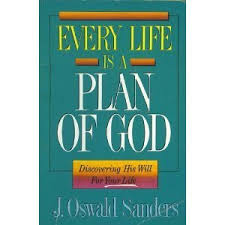
Every Life Is a Plan of God [J. Oswald Sanders]

sandersWho knew that the minor half of the dynamic duo was a theologian? Robin sums up Sander’s book in rather a succinct way,

The way we get into these scrapes and get out of them, it’s almost as though someone was dreaming up these situations [and] guiding our destiny.

Oswald himself states [pg 39],

God has a plan for every life. Our circumstances are not accidental but planned by Him.

In this book, Sanders attempts to answer the question: Is every life a plan of God? Many Christians reference a “blueprint” or “a plan” that God has for each and every individual. If Sander’s statement doesn’t qualify as a “blueprint” statement, then I don’t know what does. I’m terribly frustrated and even feel poisoned in my own Christian perspective regarding God’s character because of “blueprint” thinking. In part, I’ve landed on an Open Theistic perspective as to my relationship with God if only because it seems impossible to rectify my own life’s circumstances (and also those of others, too) from the lens of Scripture. If I were to believe that situations are not by accident and were in fact planned for and otherwise ordained by God, then it only stands to reason that God intentionally brought about evil and horrible things like: the Holocaust, rape, murder, personal suffering, mass starvation, disease, infirmity and all that is NOT the fruit of the spirit. I’ve yet to find a proponent of the “blueprint” giving thanks for the political decisions that brought about abortion, gay marriage, transgendered bathrooms or a host of other moral dilemmas.

The number of times I come across “blueprint” thinking is mind-boggling. Below are a few examples which help to make my point:

1) The 1942 movie, Pride of the Yankees in which Lou Gehrig learns that he has contracted ALS:

  • Lou: “Give it to me straight, doc. Is it three strikes?”
  • Doc: “Yes, Lou, I’m afraid so.”
  • Lou: “Well, I’ve learned something over my life. You can’t change the call of the umpire.”

2) A former beauty pageant contestant who, many believe, lost the Miss America contest because of her answer to a question about same-sex marriage. Afterwards, Carrie Prejean was quoted as saying,

God chose me for that moment.

3) Then Speaker of the House Nancy Pelosi referred to presidential candidate Barack Obama as “a leader that God has blessed us with at this time.” We’ve reached a new theological realm relating to the will of God when liberal or conservative politicians exude religious overtones.

http://www.politico.com/blogs/bensmith/0808/Obama_I_will_win.html

4) A short summary of Wall Drug Store’s history states:

  • Our families agreed that we should all pray about the decision to buy a small drug store in Wall, SD in 1931.
  • We asked God’s guidance.
  • In the end, everyone felt that it was God’s will for us to go to Wall.
  • But now [that we’re all alone in SD], we wondered if we’d heard God right.

Was it God’s will for Wall Drug to prosper during the middle 1930s when so many people and businesses were struggling through the Great Depression? If so, then it seems reasonable to believe that God picks and chooses which businesses will thrive and which ones will fail. If that is so, then it seems reasonable to believe that God wills for many people to suffer financially.

5) A blog was set up on our church’s web site to allow for comments on the pastor’s summer sermon series. A statement from one commenter related to the will of God pertaining to the adoption of two daughters:

[I’m reminded] from Bible verses [that] God has plans to prosper and not to harm me (Jeremiah 29:11) and that God works all things for the good of those that love Him and are called according to His purpose (Romans 8:28) to radio songs about [how I should surrender] my life completely to God. I’ve never been happier in my life. To top it off, God has met all of our financial needs and even most of our wants.

I posted the following response:

The overriding perception is that you’re trusting God based not only on the feelings you’ve experienced but also on the outcome. Ultimately, you felt that this direction was the right thing to do and the outcome of that decision – being that you’ve never been happier and aren’t lacking for anything has validated that decision. Who am I to say that you’re not right? Maybe God did lead you. Still, I find it troubling that non-Christians could use the same logic and draw the same conclusions based on similar experiences. How is it that Christians today lay claim to God prospering them today based on Jer 29:11? This is indeed what scripture says. However, is this what scripture teaches? The reference in Jeremiah is a historical event wherein God gave a promise to those whom Nebuchadnezzar had exiled from Jerusalem to Babylon. Furthermore, there was a seventy-year period from when the promise was given to the promise’s eventual fulfillment. In addition, I don’t think the Rom 8:28 reference supports your contention that God “willed” you into a specific direction as I don’t see the verse saying that God directs everything.

6) Not sure where another church-friend got this quote:

I’m realizing that the most important thing I can do is give up the control I think I have over my own life so that the Lord can bring about His control in my life. I need to trust and give up control.

What’s so astonishing about this quote is that just two years prior, this same person emphatically stated how it was God’s will that they should buy a particular house. In answer to my question as to how they knew that, the response was, “Well, we got the house, didn’t we.” And now, suffice it to say, higher mortgage payments coupled with other poor financial dealings are putting a severe strain on this couple’s relationship – not only with each other but also (as I see it) with God. I sense an inability (maybe an unwillingness?) to understand how poor financial decisions and not “the will of God” has brought about their current difficulties. And, too, I sense that admitting to mistakes is to admit that they were exercising a false faith by believing that God chose that house for in the first place.

Perhaps this couple is living-out a “blind faith”. Interestingly enough, Webster’s dictionary definition of the word ‘blind’ clarifies what I believe to be the root cause of this couple’s difficulties:

  • Unable or unwilling to discern or judge.
  • Having no regard to rational discrimination, guidance, or restriction.
  • Made or done without sight of certain objects or knowledge of certain facts that could serve for guidance.

The reality is that God has provided a “wealth” (pun intended) of information about money-matters. It appears to me that this couple is experiencing the (natural occurring) consequences of financial decisions that are inconsistent with biblically based money management practices. In reality, then, [so far as I believe] this couple’s current financial difficulties have nothing to do with God’s will.

7) Joni Eareckson Tada dealt with breast cancer a few years ago. In a video to her supporters, she stated,

Our afflictions come from the hand of our all wise and sovereign God.

According to Joni, then, God gave her cancer. Well, not to sound harsh, but given her own words, is not doubt revealed in God’s “all wise” and “sovereign” plan or might there be there an expressed lack of confidence in God’s ability to heal displayed when Joni seeks out medical assistance i.e. surgery, chemotherapy and radiation? After all, according to Joni, it was God who determined that she was to contract cancer. Why, then, would she want to be cancer-free?

8) A letter posted on a Caring Bridge web site for a young boy with acute myelogenous leukemia:

God has so many ways to teach patience – and all of the other Fruits of the Spirit. Keep remembering that you are all doing God’s work right now. What a blessed job you are called to do – what an awesome job you all are doing! Thank you for being faithful servants. What an example you are to the rest of us. Rose

I’m sure Rose is well intentioned. However, her comments raise a number of questions about who she believes God to be and how He interacts with us. Perhaps Rose is a “Godwillian” believing that whatever happens, God desires it to be, and us mere mortals need to figure out what it is that God wants us to learn from it.

9) I’m convinced that John Piper is a Godwillian. He’s quoted in Is God to Blame (pg 48) as saying:

From the smallest thing to the greatest thing, good and evil, happy and sad, pagan and Christian, pain and pleasure – God governs them all for His wise and just and good purpose.

Greg Boyd’s response follows on pg 53:

Not once did Jesus suggest that a person’s afflictions were brought about or specifically allowed by God as part of a ‘secret plan’. Nor did [Jesus] suggest that some people suffered because God was punishing them or teaching them a lesson. [Jesus] didn’t ask people what they might have done to get in the sad predicament they found themselves in – even when dealing with demonized people. Jesus never suggested that a person’s suffering was brought about to contribute to a ‘higher harmony’. To the contrary, Jesus consistently revealed God’s will for people by healing them of their infirmities.

I’m told that my thoughts on will-of-God issues tend to put God in a box. We mere mortals simply can’t understand the nature of God and how He interacts with His creation. Fair enough. But I can’t help but think the folks noted above make God out to be something He isn’t.

Has God placed particular people in particular positions at particular times for His end-results? The Apostle Paul, of course, had his Damascus Road experience. And Jesus chose those whom He wanted as His disciples. That said, from my reading and understanding of the Bible (primarily of the New Testament), it is exceedingly rare that God chose specific people for certain tasks. Furthermore, in my opinion, those instances only occurred during the early formation of the Church.

I regret my disappointment and frustrations as I read through Sander’s book because I find (albeit this is certainly not Sander’s intention) that God is reduced to nothing more than a Pol Pot, Adolf Hitler, Joseph Stalin or for that matter any common thief or serial murderer. As an example, Sander references the missionary work of William Carey [pg17] in which ten years of translation work were destroyed in a fire. Carey’s emphasized two points in his first sermon after the fire:

  1. It’s God’s right to “dispose of us” (emphasis mine) as He chooses.
  2. It’s our duty to “accept God’s choice.”

Really? REALLY?? This is Calvinist perspective and is not consistent with Jesus’ teaching that God is love. Or if it is, count me as a non-believer.

It’s unfortunately, too, that Sanders uses utter nonsense in the misapplication of Rom 9 by quoting Morgan Derham in his book “The Mature Christian”. The point of Rom 9 is God’s grace now being offered through faith to both the Jew and the Gentile and not, as Derham infers, that it’s up to God (the potter) to do to us (the clay) as he sees fit.

In fairness, I find it difficult to effectively argue against verses such as Ps 32:8-9 or Eph 2:10 [pg 35-36] as to God having an individual will. It would be my opinion, however, that these verses are not related to a specific will, per se, but rather we’re being instructed to follow God’s moral will in our lives.

As best I could, I slogged through the book eventually landing on chapter 8: “Walking in Wisdom – Cautions About Guidance” [pg 149]. What? Huh?? Really??? This book has referenced perhaps 250 verses of scripture in order to understand divine leading. And now, [pg 152] Sanders states, “Be suspicious of any purported leading that would help us to sidestep a difficult choice that has the appearance of the will of God.” NOW I AM TO BE SUSPICIOUS?? Really?? You’ve got to be kidding me because in one sentence, Sander’s book has devolved into nonsense – or worse, a fraudulent belief. Or, would it be accurate to say a faith based on a myth? Interestingly enough, Sanders discusses [pg 26-28] nine myths of God’s will. In essence, everything boils down to something along the lines of, “Well, it might be God leading. But, it might not be God leading.” Not only is this illogical, it’s also nothing but ‘Christianese’ – put rather curtly – good sounding male bovine spiritual manure.

I’d like to believe that the debate between Calvinists and Arminians doesn’t really matter. But this debate is clearly relevant in how I perceive God’s character. So, where do I go or what do I do with all this theological turmoil? A good friend once asked the question:

If one takes away all of the questions, all of the assumptions, all of the preconceived notions that we as believers have – what’s left?

I’m not sure. I’ve been struggling to understand the nature and character of God and in all honesty, my relationship to my heavenly Father has been at best distant as I’ve struggled through such issues as the will of God and predestination as advocated by ardent Calvinists. Perhaps, as my friend finally stated, it all boils down to the simplicity of believing as spelled out in the Apostle’s Creed:

  • I believe in God the Father, Almighty, Maker of heaven and earth
  • And in Jesus Christ, his only begotten Son, our Lord
  • Who was conceived by the Holy Ghost, born of the Virgin Mary
  • Suffered under Pontius Pilate; was crucified, dead and buried: He descended into hell
  • The third day he rose again from the dead
  • He ascended into heaven, and sits at the right hand of God the Father Almighty
  • From thence he shall come to judge the quick and the dead
  • I believe in the Holy Ghost
  • I believe in the holy catholic church: the communion of saints
  • The forgiveness of sin
  • The resurrection of the body
  • And the life everlasting

I hope it’s enough. It’ll have to do for now. 

An Approach to Knowing God’s Will

diceThis post came about as a response to a ten page term paper written by a friend. I regret I’m unable to link to the paper in which is presented a defense of knowing specifically how God is leading each and every individual. Although not specifically stated, the overtone from my Calvinist friend is that God not only leads believers, but that he also leads and directs non-believers.

The three main themes from An Approach to Knowing God’s Will is that God:

  1. Has a will for all people
  2. Has a will for all Christians
  3. Has a specific will for each Christian

I’m in agreement with the first two parts that God has a will for all people which is – to be saved. Obviously, even if I’m not a Calvinist. I’m also in agreement that God has a will for all Christians – which I’d refer to as the “moral will”. The book of Proverbs & Rom 12 immediately come to mind as to general conduct for believers (and, I’d also add, non-believers, too).

The third point that God has a specific will for each Christian is our main difference. Your conclusion states that the Spirit leads specifically “as to the type and place of service.” In addition, you add that God leads and directs individuals to any number of other things including the church one should join, what one’s spiritual service should be, whom to marry, which house to buy, what car to purchase, etc. After all, “[God] knows what’s best for me.”

I find it ever curious that the Bible is replete with general principles and apparent guidelines for (what I believe to be) the express purpose of decision-making. It seems self-evident that God wanted us to have an “instructional guide” to make wise decisions. To which, we’ve been given the Book of Proverbs. By using biblical principles, I can make wise – and I would even say, godly decision as to any number of things – personal, financial or moral.

I don’t believe that I’ve been led to a particular church. In fact, we’ve attended five different churches in the 32 years we’ve lived in the Twin Cities. The reasons we left a given church are perhaps not germane to this discussion. However, suffice it to say that different churches have appealed to me at different times in my life. Ultimately, my criteria for a church is rather simple:

  1. Do I like the overall configuration of the service?
  2. Is the church evangelical in nature?
  3. Can I be “fed” or otherwise grow spiritually?
  4. Is there a ministry where I can serve?
  5. Is the church within reasonable proximity to where I live?

Lastly, as to what line of work (spiritual service) – how’s ‘bout whatever’s within your “bent” or natural abilities? For me, I can’t work with kids. I hate the chaos and occasional talk-back and discipline issues. On the other hand, I have no fear of walking up to someone and introducing myself. I must have the gift of hospitality. To which, I’m a greeter. My “job” each Sunday is to intentionally seek out people I don’t know for the express purpose of welcoming them. 

Decision-making is often difficult and stressful if for no other reason than there is incomplete information. And, the full impact of decisions can’t always been known. Obviously, some decisions made are better than others. However, as I look at some of Paul’s writings, it’s apparent that God allowed Paul to freely make decisions. Below are some instances where Paul exercised decision-making. I’ve included a paraphrase for the issue/concern at hand:

  • Phil 2:25 (I think it’s a good idea)
  • 1 Cor 16:3-4 (If it seems the right thing to do)
  • Acts 6:1-7 (We need to do something about this)
  • Acts 15:24-29 (People got together, debated, decided, and acted)

A letter sent from our church’s board of elders to the congregation illustrates Paul’s examples: 

After evaluating recent giving patterns to the general fund, the elders have determined (emphasis mine) that we must take a decisive step toward “right sizing” our current staffing numbers.

Clearly, the board didn’t “wait upon the Lord”. Nor did the elders indicate any divinely received indication as to whose employment should be terminated. Rather, they have given this difficult decision its due consideration and, I believe, exercised care and concern by way of:

  • Analysis – “After evaluating recent giving patterns”
  • Collective wisdom – “After much prayer and discussion”
  • Decision – “We must take a decisive step”
  • Reflection – “This was not an easy decision”

Nowhere are there passages where Paul explains such things as open doors, closed windows or otherwise how God guides individuals. Nor do I find a “method” by which one can ascertain the “will of God”. Instead, Paul describes in various places just what comprises the “will of God”. Interestingly enough, there’s no ambiguity or uncertainty. Romans 12 is a clear and concise outline of God’s will for how we should live:

Rom 12:1      Dedicate your body to God

Rom 12:2      Be transformed. Put on new man

Rom 12:3      Don’t overestimate yourself. Rate your own ability soberly

Rom 12:6-7  Use your gift and give yourself to it

Rom 12:9      Love with sincerity

Rom 12:9      Hate evil and turn from it

Rom 12:9      Hold fast to that which is good

Rom 12:10     Love one another. Prefer one another

Rom 12:11     Never lag in zeal and earnest endeavor

Rom 12:11     Be aglow with the spirit, serving the Lord

Rom 12:12     Rejoice and exult in hope

Rom 12:12     Be steadfast under pressure

Rom 12:12     [Be] Patient in suffering

Rom 12:12     Constant in prayer

Rom 12:13     Give

Rom 12:14     Bless those who persecute you

Rom 12:15     Share others’ lives, give of yourself

Rom 12:16     Live in harmony – adjust

Rom 12:17     Repay no one evil for evil

Rom 12:17     Be honest and above reproach. Avoid the appearance of evil

Rom 12:18     Live at peace with everyone

Rom 12:19     Avenge not yourself

Rom 12:20     Do good to your enemies

Rom 12:21     Overcome evil with good

In conclusion, I don’t see the Bible teaching that God routinely directs the decisions we make. That said, I would agree that it has been the rare exception when God directly intervenes with someone i.e. Paul’s Damascus Road experience. And even for those actually guided directly by God, so far as I can tell, that guidance appears only related to evangelism. To paraphrase Garry Friesen from his book, Decision Making and the Will of God: Any decision made that does not violate God’s moral laws is acceptable to God and even brings about honor and glory to him.

The New Kid on the Block and Giving “Greet”

two_boys_bat_larger[1]

I’m not sure that the local church I attend is declining, per se. However, it’s safe to say, however, that we’ve lost congregants over the last five years. If nothing else, it seems we’ve lost a number of members and that overall our church’s growth has stagnated. I’ve personally counted ~150 first time visitors over the last year and the sad reality is that very few of them return for a second visit. No doubt there are many dynamics that feed into the overall health of a church – of which one of them is certainly the willingness of the body to reach out and welcome the visitors. To that end, I never really understood the nature or the necessity of a greeting ministry until I was asked to lead one some time ago. In the hope of generating more interest in the greeting ministry, I was asked to write something for our church’s newsletter. What follows is my attempt to get people to get out of their all too often cloistered little cliques and open themselves up to the first-time visitors we continually see on a regular basis.  

My dad’s job promotion necessitated a transfer to a new city. Having left close friends and comfortable surroundings behind, I was feeling isolated and alone. The doorbell rang about mid-morning on the day after the move. I went to investigate and saw well-worn sneakers as I was coming down the stairs. Another couple of steps and I noticed a band-aid on a knee. Another step and I recognized the outlines of a baseball glove. Suddenly, standing before me were two boys who happened to be my age and one of them says, “Hi, wanna play baseball?” I was out the door in a shot and yelled back at the house that I’d be back later.

Although I didn’t understand it at the time, this was my first introduction to the importance of “greeting”. Without realizing it, I immediately felt welcomed and accepted. Unfortunately, I’ve also experienced the harsh reality of being an “outsider”. When the Coast Guard cutters I served on pulled into port, I’d venture into town on Sunday mornings to find a local church. Walking into a church and nobody taking notice of me was depressing. Being around a bunch of “salty” Coast Guard sailors was tough enough. However, feeling rejected by those who are supposed to “love one another” literally knocked the “faith-wind” out of my sails.

Even today, it’s difficult visiting churches. In two of the four churches I visited as part of the Vision 2020 campaign a couple of years ago, nobody introduced themselves to me. Sadly, walking into a church for the first time is all too often an awkward and uncomfortable situation. Saturday Night Live skits are made of the commonality of this experience.

I was asked to lead the greeter ministry four years ago and initially said, “No, I don’t think so. The last thing I want to do is stand at a door. Should I see new people, I’d want to interact with them, show them around, get them a cup of coffee, introduce them to the pastor and otherwise help them get ‘the lay of the land’. Anyone coming in afterwards would have to open up their own door.” The response was an enthusiastic, “That’d be great! When can you start?”

Most of us here have been around long enough to identify the regular attenders. By default, then, we also recognize the “newbies”. On average, three people attend Woodcrest each week for the very first time. Sadly, only a small percentage of our visitors return the following Sunday. The whole point of the greeter ministry, then, is intentionally seeking out those visitors and ensuring that they’re warmly welcomed.

The reality is that greeting is such a relatively easy thing to do. Honestly, who can’t perform the basic greeting functions of a smile, a handshake and a pleasant “hello”? Moreover, it’s so easy to “graduate” to the next level – whether one is on the greeting team or not. Anybody can [and should!] help our visitors feel more comfortable through simple actions such as:

–          Say, “Hi, I’m [name]. I don’t think we’ve met before. Are you new here?”

–          Ask the visitor if they’d like a cup of coffee.

–          Invite visitors to the fellowship time between services.

–          Point out where the bathrooms are.

–          Help escort parents with small children to the children’s area.

–          If necessary, introduce visitors to any of the greeters, elders or staff members if there’s a specific question or need.

Therefore, isn’t everyone in this body of believers a greeter – not only for first time visitors but also for those regular attenders all around us whose name we don’t know? The only difference for being on the greeting team, then, is a desire to intentionally seek out the “newbies” in our midst – those visiting for the very first time. They are the greeting team’s mission field.

Finally, I would invite you to walk with any of the “official greeters” on a Sunday as we “rove” the narthex and worship area prior to the start of the service. Seeing eyes light up and faces relax as we greet our visitors is such a joy. Until you’ve seen it for yourself, you truly don’t know what you’re missing. In addition, as we greet and become more familiar with each other, we recognize needs and can use our specific gifts to help build each other up. The end-result is that we’ll ultimately becomes a stronger and more dynamic body of believers.

As such, whether as a part of the “designated greeting team” or not, are you willing, as John Wayne would have said, to “Give’m greet?”

FWIW – My 2014 Top Five Blog Posts

images-1Got my year-end WordPress stats indicating which posts received the most visits during 2014 (listed by popularity):

The will of God will never take you where the grace of God will not protect you

Two-Point Calvinism – Is That an Acceptable Alternative?

If God Can Be Surprised by His Creation, Can Calvinists Really Claim Unconditional Election?

A Sleep-Study; It’s a ‘Weird’ Feeling – Feeling ‘Wired’

Is John 3:16 The Most Misunderstood Verse in the Bible?

Interesting, over the last 4 years, these particular posts have attracted the most traffic in 2014. However, none of the ‘top-5’ were written in 2014. Still, I’m humbled to think that people are interested in anything I’ve espoused. On the other hand, it makes me wonder if there are other soul-seekers also experiencing discordance within their own Christian faith? Anyway, for those who seem to stop by periodically, perhaps this list will help direct you to what others on this blog appear most interested in. 

In any event – Best Regards and Happy New Year – especially to my good blogging buddy Tim Elder.

Looking Ahead, Seeing Nothing

IMG_2324It has felt as though the fog on this faith-journey over the last couple of years is so thick that I can’t see ahead, behind or even to either side. I’ve lost my bearings as to where I was much less understand where I’m at now, where I’m going or even if I’m moving in any direction. I was recently asked if the effort figuring out Calvinism/Arminianism is really worth it. Wouldn’t my time be better put towards developing a deeper relationship with Jesus? Sure. I could just decide – yes, I’m firmly in camp “X”. However, the doubts and the confusion would remain if only because the logical disconnect of competing doctrines essentially using the same scriptural references to justify their respective positions is, at least to me, such a dichotomy.

Still, I recently saw this question posed on an Open Theist web site: 

  • If everything has been predetermined before all of us exist, then, would prayer help at all?

That question immediately made me think of the movie Groundhog Day in which TV weatherman Phil Connors (Bill Murray) was in some sort of time-loop and had to relive the same day numerous times until, I presume, he got it right. I don’t think it was the movie creator’s intention, but it was almost as though there was a predetermined outcome that had to be gotten right before Phil was able to move on.

There were, as one might expect, numerous responses from all perspectives of which one in particular got my attention. I’ve edited it for readability: 

I spent many long years as a Calvinist. I continually shouted at God to help me change the very hard and painful circumstances of my life. However, nothing changed. I knew it was futile anyway because God had apparently decided to leave me in those circumstances. I tried all the pat answers:

  • The C. S. Lewis option – prayer changes us, not God.
  • The faith option – if I express genuine faith – and lots of it i.e. the faith of a mustard seed, then I’ll see changes happen.
  • The Job option – I must have sin somewhere that is stopping God from hearing me.
  • The passive option – God has my best interests at heart.

However, in the end I had to accept the horrible thing that had happened was the best of all possible options. It wasn’t until I really embraced Open Theism that prayer became something dynamic and a means of genuine communication. As it was, my previous prayer life was more of an information dump wherein character X (me) protested as to why the author (God) wrote the story. And, the author (God) explained to character X (me) that it was okay if I never understood why the story was written was written as it was.

Ironically, I think this poor schlep has really hit on something. The ardent Calvinists I know are confident that no matter what happens, God is in control. Perhaps to a slightly lesser degree, these same Calvinists will claim that any and everything that happens to each and every one (elect and non-elect alike) is as a direct result of God’s sovereignty in order to enable a particular outcome that brings about greater glory to God.

If that’s true – that there’s no free will and this poor schlep converts from Calvinism to Open Theism and finds that his prayer life has become dynamic, is this poor schlep wallowing in his own misunderstanding of God’s “plan” and experiencing a sort of “false comfort” based on, perhaps, self-motive? After all, God didn’t change, right? Rather, this poor schlep’s perspective of God changed. So, is this poor schlep feeling better about his faith because he decided to identify with something which apparently was more comfortable? On the other hand, if there is free will and God isn’t sovereignly controlling each and every detail, then is this poor schlep experiencing a newfound joy and sense of freedom because he now understands or otherwise relates to God from a proper perspective?

Honestly, how is one to know?

Caption picture graciously provided by LT. More of his fabulous pictures can be found here.

Merry Calvismas

Wayne Moran PhotographyToday’s sermon was based on the familiar passage of Luke 2:8-20. Two verses in particular popped out at me (NIV) – emphasis added:

(10) But the angel said to them, “Do not be afraid. I bring you good news of great joy that will be for all the people.

(14) Glory to God in the highest, and on earth peace to men on whom his favor rests.

Certainly my faith has diminished over the last few years while trying to make sense of what I can only call the Calvinist divide. And, irrespective of my good buddy Tim, many who hold dear Calvinist doctrines have been ever gracious and patient while I try to work through myCalvinisticals”.

Yet, here’s this particular passage – and with a clear reading (at least from my perspective), there’s obviously a disconnect as to whom the Messiah came for:

– all the people (as stated in vs 10)

– those on whom [God’s] favor rests (as stated in vs 14)

Not sure why I hadn’t noticed this particular text over the past few Christmas seasons. Certainly I’ve come across these verses numerous times before. Still, in my feeble mind, it is impossible for Calvinism and Arminianism to logically coexist. Yet, here within these verses is to me a contradiction of the highest order.

And for me, the struggle continues.

I welcome your thoughts.

BTW – The captioned picture, I think, represents well the two doctrines of Calvinism and Arminianism moving down one’s faith path. To me, there is no intersection. Anyway, some fabulous pictures can be found at http://www.lettherebelightfineart.com/

Christian Clarity Review Lives! But, Does Anybody Care?


DSC02487It’s been some time since I visited Christian Clarity Review and was surprised that there hasn’t been a posting for the better part of a year. You should know that Tim banished me from his site (scroll towards the end of the comments) and I’ve honored his request. Still, curiosity got the best of me and with a couple of quick Google searches I found an obituary for one Monroe Timothy Elder.

http://www.cljnews.com/20120106monroe-timothy-elder-sr

However, I was confused as the date of death was listed as 1/3/12. Yet, Tim’s last post on the CCR blog was 3/13/13. Perhaps against better judgement, I commented the following on Tim’s last post:

Dear Tim,

It’s been quite a while since I’ve seen any blog postings from you. Yes, I’ve been stopping by from time to time since you banished me from this blog. Still, a quick Google search turns up an obituary as to your death on 1/3/12. And yet, your last post was 3/31/13. I’m not sure just what to make of that. Nevertheless, in spite of our sometimes acrimonious responses to each other on our respective blogs, I’m hoping that I only discovered that there’s another Timothy Elder and that you are indeed alive and well.

Sincerely,

Bob

In short order, Tim spat out the characteristic love and affirmation I’ve previously experienced. Note: I’ve incorporated the hyperlinks below for convenience.

Feelin’ the flames already Bob? That lying spirit in your flesh getting itchy?

That was my Dad. I’m a Jr.

2equals5 that’s God through me too, Christian Clarity and the Archives on Blogger. God through me too.

I’ve always posted infrequently. Why speak to the deaf?

Jer 23:17 They say constantly unto them that despise me, Jehovah hath said, Ye shall have peace. And they say unto every one that walketh in the stubbornness of his heart, No evil shall come upon you. For who hath stood in the council of Jehovah, so that he hath perceived and heard his word? who hath hearkened to his word and listened? Behold, a tempest of Jehovah, fury is gone forth, yea, a whirling storm: it shall whirl down upon the head of the wicked.

You really think you and those of your kind will wash God’s windshield at a stoplight and then demand salvation in payment for your “free willed” charity? The Christmas season makes a difference?

It’s not something else Bob. You’re just a liar. We’re not brothers and not friends.

But do the tradition this year. Again. Sing the songs, do the fake sacrifices in the famine of the Word of the Lord on you. Be Happy..all that.

Hosea 4:18-19 Their drink is sour; they give themselves up to whoredom; her great men passionately love their shame. The wind hath wrapped her up in its wings, and they shall be ashamed because of their sacrifices.

In the Name of Jesus Christ, Amen

Indeed, Tim is alive and full of vigor and genuine warmth. First of all, my apologies to Tim’s late father for having mistaken him for his son all these years. It never cross my mind that the Tim of Christian Clarity Review was a jr. Oh well, I never did claim to be the sharpest tack in the box.

FWIW, shortly after I began this blog, I discovered Christian Clarity Review and we commented back and forth on a couple of topics. So, why did I engage or otherwise respond to Tim’s posts? Many would say it’s unfair, but I actually find Tim to be the “center-point” of Calvinistic doctrine. He himself states on his home page: “Two languages in total reality mandate the five points of Calvinism”. Furthermore, I believe that his interactions with myself and others who have dared challenge his beliefs (or even to try and understand what he’s talking about) are the natural occurring manifestation of Calvinistic thought.

Tim states his belief in Calvinistic doctrine here.

So then, what is one who struggles with Calvinism in general and the concept of unconditional election in particular to think about all that is contained within Christian Clarity Review? Not much, I suppose. Without exception, ALL of the Calvinists I come into contact with are good and decent people who do their best to help me understand (what they at least believe is) the truth. However, I believe it impossible for Calvinism and Arminianism to logically co-exist. That both sides use many of the same scriptural texts (with much conviction, no less) to support their respective arguments continues to baffle me.

I know that Tim’s opinions, writings and ad hock attacks represent a very small percentage of Calvinists. Unfortunately, as noted above, I believe that Calvinistic doctrine fundamentally breaks down into the likes of one Monroe Timothy Elder Jr.

Yes, Christian Clarity Review lives. But in reality, does anybody really care?